
Tag Archives: UAE

Interview with… Thierry Nicault

Forty per cent of UAE workers are already using Generative AI, and nearly 80 per cent believe that AI will bring more productivity to the workplace.

These were among the findings of research done in the region by Salesforce, the global leader in AI Customer Relationship Management (CRM), and highlighted recently at its annual Salesforce World Tour Essentials Dubai event held at Madinat Jumeirah.

This enthusiasm for the latest generation of AI and cloud-based technology was amply evident at the event, which was packed with over 2,000 customers, partners and associates, including senior attendees from government, retail, real estate, energy, and banking sectors in the region.

It’s also clear from the scale of Salesforce’s investments in the region – according to IDC estimates. The company will generate more than $5.1 billion in net new business and create more than 21,800 jobs in the UAE by 2028, fuelled by AI-powered cloud solutions.

“This is a testimony to the importance and visibility of the region to our company,” says Thierry Nicault, Area Vice President, Middle East, Salesforce. “Our team is growing here locally, we are expanding our presence, and there is a huge growth in our ecosystem.”
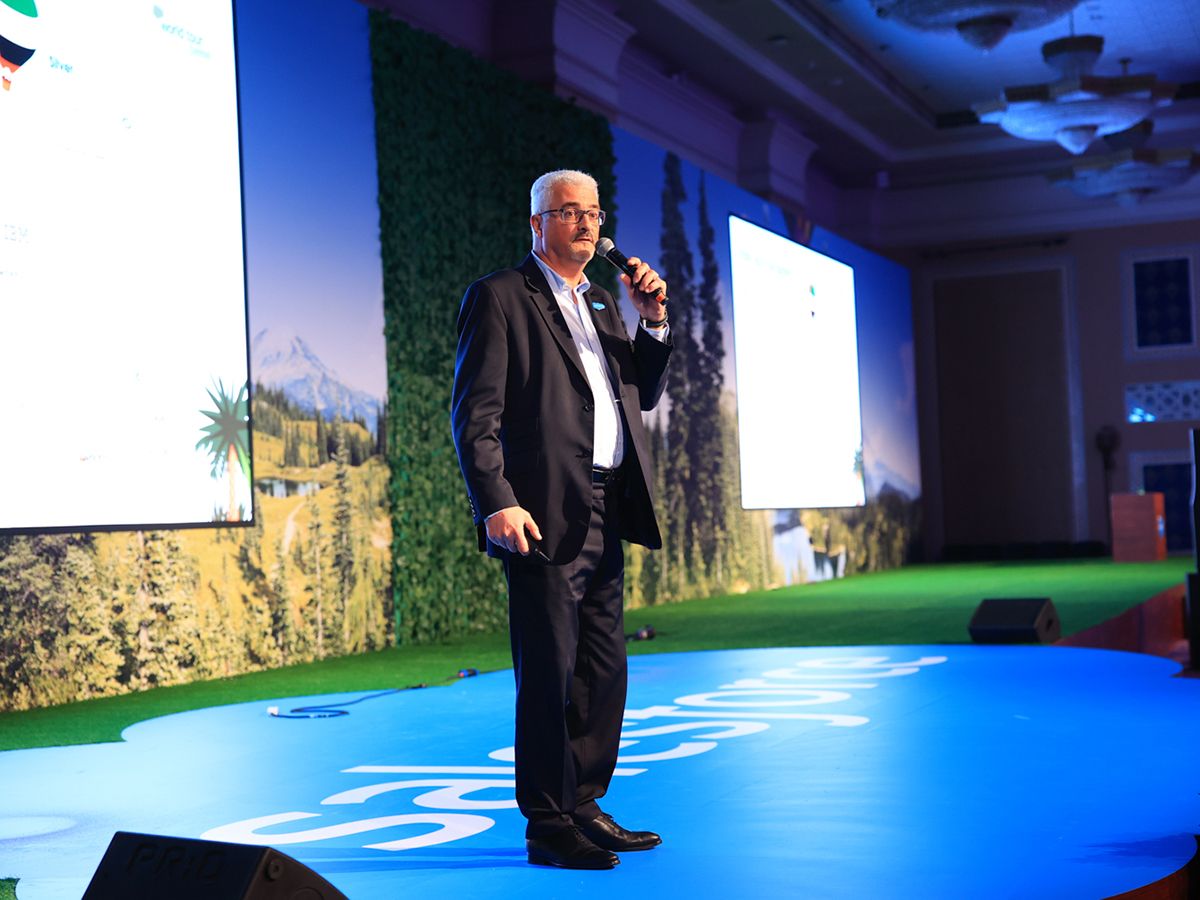
Image credit: Gulf News

Einstein 1

At the heart of this growth is the newly launched Einstein 1 platform, which embeds Generative AI into workflow processes across all Salesforce applications, including sales, service, marketing, ecommerce and analytics. Data, of course, is at the centre of this revolutionary technology – specifically Data Cloud, a platform that creates a holistic customer view by integrating reams of organisations’ existing, disconnected data, and fuses it with Generative AI to improve both customer engagement and employee productivity.

“Seventy-one per cent of companies in the enterprise space have siloed data, on lots of different systems and models, spread across old and new systems. Einstein 1 allows you to ensure that this data will be actionable in your business,” says Nicault. “The key part is that we’re using Gen AI on your company’s grounded data, which you have built for the past few decades and spent millions to maintain, and not on internet or public domain data.”

The company has agreements with leading data providers such as Snowflake, Google Cloud, AWS, MS Azure, and Databricks to allow such integrations securely. This goldmine of company-specific data combined with Generative AI allows the seamless automation of processes, and the reduction of repetitive tasks which, Salesforce research shows, takes up 62 per cent of employees’ time at present.

“The result is a combination of improved employee productivity and better customer service, bringing a lot of value in terms of the ability to decrease costs while increasing customer satisfaction,” Nicault says.

Making a mark in the Middle East

This increase in efficiency and productivity is the reason for the rapid adoption of such AI and cloud technology in the region, since it matches the UAE’s ‘growth mindset’, explains Nicault.

“The government’s vision to build this country as an economic, tourist and cultural destination is absolutely amazing. Our cloud and AI-powered CRM solutions support this because they are effective across sectors including travel, retail and real estate, and it’s starting to pick up very nicely in healthcare and banking, and the public sector,” he says, adding that local case studies have shown that the platform brings about steady growth without organisations having to increase their workforce thanks to improved productivity.

Need for training

The issue, of course, is that such assimilation of evolving technology can bring with it a skills gap, and according to Salesforce’s research, employers in the UAE have some work to do. Findings show that 52 per cent of workers have not been trained to use Generative AI, and 64 per cent say that employers haven’t set any guidelines for Gen AI usage.

This mismatch between the use of AI and training in AI is among the reasons why Salesforce places such an emphasis on training and education, as demonstrated by its 35 per cent increase in partner certifications and its support for technology skills in the region. “Our job has always been to help democratise technology,” says Nicault. “One way we do that is through our free training website, Trailhead, which allows anybody to learn in-demand skills, earn credentials, and connect to opportunities. The second thing is that we have specific programmes and regular workshops to help our partners up-skill. And thirdly, we are engaging with external organisations and associations such as ArabiaForce Academy, which helps to upskill the Arabic-speaking world.”

It’s also why the company is taking a leadership role in AI through Einstein Trust Layer, a robust set of features and guardrails that protect the privacy and security of organisations’ data, improves the safety and accuracy of their AI results, and promote the responsible use of AI across the Salesforce ecosystem.

“We have taken time to ensure that our Gen AI features and services are accurate and safe to use,” Nicault says. “We may not be seen as the fastest innovator in AI, but we do it fast in the most secure way possible.”

This article originally appeared in Reach by Gulf News. You can find it here

Leave a comment

Filed under Articles, Technology

Launch: GenniusXYZ’s Global Hub in Dubai

Imagine as One reimagines loyalty programmes offering users a centralised secure location

Gennius XYZ, a Florida-based fintech company, recently launched its latest digital platform, Imagine as One, during the grand opening of its Dubai base, the Gennius Global Hub. One currency, one wallet, and one simple way to unify various digital assets and facilitate effortless transactions across boundaries — that is what its latest platform promises consumers in the Middle East and North Africa (Mena).

Supported by Seed Group, a company of The Private Office of Sheikh Saeed Bin Ahmed Al Maktoum, Gennius XYZ released its latest digital platform at The World as One event on May 9 before movers and shakers of the finance industry in the city. Against the glittering backdrop of the Burj Khalifa on the top floor of the upscale The Lana hotel in Business Bay, the event was the perfect setting for the first glimpse of this futuristic technology.

“Today marks a significant milestone as we launch the Gennius Global Hub in Dubai and unveil our The World as One programme,” said Sergio Arana, CEO and Founder of Gennius XYZ at the launch. “This initiative represents not just a step but a giant leap forward in redefining global loyalty systems. The most important part is its philosophy: the unity, the concept of The World as One. Imagine what we can do — how we can mix currencies, wallets, many different assets, and technology to make it simple for consumers.”

Capital of digital strategy

The Gennius XYZ Global Hub comes to Dubai after nearly one year of development and customisation for the market, working closely in partnership with the Seed Group. “We have 17 million users active on the platform worldwide, but at the end of the day, every market, [and] every country is unique,” said Arana.

Calling Dubai ‘the capital of digital strategy’, he expressed gratitude to Hisham Al Gurg, CEO and Co-founder of Seed Group, for giving Gennius XYZ a chance to expand into the region and globally. “We are a small company, but I believed that together we could build something big, something different.”

That belief was the catalyst for the partnership. “A year ago, we facilitated the smooth entry of Gennius XYZ into Dubai and the larger Mena market, which marked the development of its then-project called The World as One. Now here we are, finally witnessing it come to life — which encompasses its latest Imagine as One digital platform — along with the inauguration of its Dubai hub,” said Al Gurg at the launch. “I think we can all agree that there couldn’t be a better headquarters than Dubai. You look at all the government initiatives launched every year, and they speak of one message: Come to Dubai, and we will support you as the government and as Royal Family members and give you all that you need.”

With two decades spent starting and running new ventures in MENA, and investments worth more than $1.06 billion under his belt, Al Gurg speaks from experience. “In our organisation, we always continue to seek the most innovative companies around the world, especially in the fintech sector,” he said. “There are so many companies to choose from, different countries, different founders. It is very challenging for any investor to find a founder with a great concept and great business model who is ready to take the steps to expand internationally.”

Customer-centric ethos

In Arana and the concept of Imagine as One, Seed Group has found that kernel of greatness. “Together, we are setting the foundation for Gennius XYZ’s global expansion, aiming to simplify and enrich the loyalty experience worldwide,” explained Arana. “Our mission is driven by technological innovation and a deep commitment to understanding and fulfilling the daily needs and aspirations of our customers. This collaborative effort is pivotal as we continue to lead and innovate in the dynamic digital landscape.”

Welcoming Gennius XYZ Global Hub to the city, Akshay Chopra of the MENA Fintech Association said, “Gennius XYZ is pioneering advancements by making loyalty and reward programmes not only interoperable but profoundly portable. This transformation breaks down the traditional barriers that have restricted the utility of digital assets, ensuring they are more accessible and adaptable for users across the globe.”

That is at the heart of the Imagine as One platform. Powered by a pioneering AI concierge service, AlleX navigator and featuring the latest in immersive technology, it allows customers to access assets — whether it is money used for in-app purchases in games such as Fortnite, miles earned on airlines, rewards earned on credit cards, or hotel stays — and transfer them seamlessly between these different platforms, to be used at the user’s convenience.

“We build our technology infrastructure to blend all of it into one transaction, to create interactions between the different environments with the same user feel,” explained Arana. “So you have one currency and one super-wallet connected across assets, and that gives you more power because if you can mix your different assets, you have more purchasing power. And you can spend it normally, as every day. Whether you are going to a supermarket or a restaurant, or purchasing online or gaming in Web 3.0, whatever your life is, we will be there.”

Imagine as One is hyper-connected with all major e-wallets, including Apple Pay, Google Pay, PayPal, Alipay, and all significant cryptocurrency wallets in the Web 3.0 realm. This integration offers unprecedented convenience, allowing consumers to manage their finances and loyalty benefits in one centralised, secure location.

Soul of Argentina

The event ended on a soaring note, as Arana unveiled the final surprise of the evening: the new ambassador for its platform, well-known Argentinian folk singer Soledad ‘La Sole’ Pastorutti. The theme of unity and The World as One came together perfectly in her soulful performance of John Lennon’s Imagine, the inspiration behind the name of the platform, accompanied by the simple strains of piano, and with Dubai’s skyline gleaming in the background.

This article appeared originally in Reach by Gulf News. You can find it here

Leave a comment

Filed under Articles, Technology

Interview with… Ghada Sawalmah

Image credit: Gulf News

The private sector is set to play a crucial role in the growth of Dubai’s dynamic and rapidly developing healthcare industry, says Ghada Sawalmah, CEO of Gargash Hospital.

“Since private hospitals are the primary investors, it is likely that the healthcare sector will experience growth driven by private hospitals in the future,” she explains. “We anticipate an increase in the number of private hospitals entering the market to take a share of the pie.”

According to current projections by the Dubai Healthcare City Authority, the UAE’s expenditure on healthcare is set to rise to Dh126 billion by 2027, with spending by the private sector growing at a projected CAGR of 8.8 per cent, compared to a CAGR of 7.5 per cent for the public sector.

Gargash Hospital is part of this burgeoning ecosystem of private hospitals, becoming the first female-owned and -led hospital in the country when it opened the doors just before the start of the COVID-19 pandemic. But Sawalmah’s understanding of the healthcare business stretches much further back – to her childhood, growing up as the daughter of two doctors, and watching her mother, Dr Husnia Gargash’s trailblazing journey as the country’s foremost fertility expert.

“I would often go to the clinics and hospitals where they worked since I was very young. I used to carefully watch my parents and their coworkers and how their actions affected the patients,” she recalls. “Being raised in a household of entrepreneurs allowed me to cultivate and enhance my business skills as well. I came to understand that my interest lay more in overseeing the business side of healthcare rather than practising as a doctor.”

The pandemic effect

That deep-seated knowledge helped Sawalmah steer the hospital through the difficult Covid years. “As a new hospital, we had to make numerous changes to our patient flow, employee management, and facility management,” she explains. “The pandemic proved to us that survival was a team sport, not only within the hospital but also within the healthcare community in Dubai. Sharing of knowledge, equipment, human resources, and PPEs was the need of the hour, and everyone stepped up to the task.”

The remarkable response to the pandemic by the UAE is one of the key reasons for the projected growth in the private healthcare sector in the upcoming years, believes Sawalmah. “After the pandemic, there has been a rise in the number of people visiting the UAE, whether for tourism or employment purposes. A significant factor for this increase is the swift and effective management of the pandemic by the UAE government.”

According to government estimates, the population of Dubai is predicted to reach 5.8 million by 2040, and when it comes to medical tourism, the UAE and Dubai, in particular, tops the list as the number one destination in the region. In 2022, the emirate received a record 674,000 medical tourists from Asia, Europe and the Middle East and North Africa, who spent Dh992 million, an increase of Dh262 million from 2021.

“This indicates that a larger number of healthcare facilities will be needed to cater to the healthcare needs of the increasing population and medical visitors,” says Sawalmah. “There will be a rise in the use of new technologies and the creation of Centres of Excellence (CoE) to draw in medical tourists. The current players will either enhance their range of services or establish strategic collaborations to grow their patient base.”

Developing such strategic collaborations is the focus of Gargash Hospital’s own evolution in the near future, including major partnerships with the likes of Tarabichi Stammberger Day Surgical Center, Swift Day Surgical Center and BritishCare. “We aim to establish ourselves as strategic allies and collaborate with other healthcare professionals to offer top-notch healthcare services to our patients,” she says.

Digital healthcare

At the heart of all this development is, of course, technology. Driven by the learnings from the COVID-19 crisis, the UAE’s digital healthcare market is projected to grow from $1.06 billion (Dh3.67 billion) in 2022 to $4.42 billion by 2030, a CAGR of a whopping 19.6 per cent, according to recent industry estimates.

However, this rapid growth and assimilation of new technologies comes with a unique set of challenges for private healthcare providers, who need to juggle the costs of the technology with shifting government regulations.

“The most recent technologies demand significant financial investments for acquisition as well as implementation,” she says. “Another obstacle is combining the latest technology with the current healthcare information system (HIS), which may involve upgrading or modifying the existing HIS, resulting in additional expenses. The regulatory requirements for digital healthcare and new technologies are always changing.”

This article originally appeared in the Gulf News. You can find it here

Leave a comment

Filed under Articles, Health

Interview with… Salem Bawazir

Photo credit: Anas Thacharpadikkal | Gulf News

Salem Bawazir, the first person of determination to be hired at Expo 2020, and the man who led the inclusion programme at that global event, has a very simple but powerful mantra for success: To see the positive in every situation, and to use the negativity that comes his way as fuel to propel himself forward.

Diagnosed with cerebral palsy as a child, the 50-year-old Emirati has spent most of his life in a wheelchair. But the biggest challenge he’s faced while trying to build a career for himself hasn’t come from physical limitations; it has come from the societal stigmas towards people with disabilities.

“There still lies a fundamental ignorance and lack of awareness of the capabilities and potential of people of determination,” he says. “This persistent societal attitude makes finding a job and having a successful career a daunting task.”

A rough ride

Entirely self-taught, he began his career at 33 as a community coordinator with a book retailer, an employment made simpler, he says, by the fact that Federal Law No. 29 of 2006 made it mandatory for companies to hire people with disabilities.

But when it was time for him to look for a new position five years later, Bawazir faced rejection from employers that left him in tears after an interview.

“A prospective employer asked me as to why I should be hired if I couldn’t even move my hands,” he recalls. “There was a question mark raised on the value that I could bring to the organisation. A lot of employers refused to hire me, and there were companies that didn’t even bother responding to my job applications.”

Undeterred Bawazir soldiered on – a stint as an HR coordinator followed, something he gave up in an attempt at forging a future as an entrepreneur. He put in a seed capital of Dh150,000 to start his own graphic design company. That initiative too ran aground, when an SME fund created to support entrepreneurial ideas like his, refused to support him with the financing required. “They didn’t believe in my ability to run my own business,” he says. It was once again a cruel reminder of how society was judging people like him, “not on ability, but on disability”. With these kind of experiences, a number of people would have just given up. Not Bawazir.

Making history

2020 heralded a turnaround when Expo rolled into Dubai. With the UAE’s renewed commitment to empower people of determination, Bawazir found himself uniquely positioned to lead the inclusion programme at Expo 2020. It was an opportunity that allowed him to work with the accessibility, health and safety, information and future technology, and construction partners at the event to ensure that people like him could make the most of the experience. In his capacity not only could he recruit and train people with disabilities, but his unwavering dedication to work helped him raise awareness about them.

“As the first person of determination to be hired at Expo 2020, I made history,” he says proudly. “I hope that it will inspire others to follow in my footsteps and break down barriers of their own.”

For Bawazir himself, the job at Expo meant that he was now more confident in the face of challenges, and there continued to be many. Ten months post Expo 2020, he struggled to find employment, but his resilience and never-say-die attitude finally paid off. Impressed by his confidence, his curiosity and a willingness to learn, a leading UAE organisation offered him his current job with the Learning and Development team in its HR department.

An inclusive future

Today Bawazir brims with positivity and hope for the future. A future, where he wants to rekindle his entrepreneurial calling, a business of his own. This time around, he will do it without any external funding, he says with a smile.

“My goal is to change people’s thoughts and beliefs, and to help a new generation embrace the principles of equality and equity for all.”

The article originally appeared in Reach by Gulf News. You can find it here

Leave a comment

Filed under Articles, Inclusion, People

Restaurant with a view, Dubai-style

A view of the Mall of the Emirates. See the ski slope?

As you’ve probably guessed from the subjects of these two most recent updates (they’ve been a long time coming, haven’t they? I’ve been a terrible blogger of late), I’ve been on a visit to Dubai. While there, I was living not far from the massive Mall of the Emirates — otherwise known as the mall with its own indoor ski slope — which pretty much dominates the landscape in the area. I mean, you can see that damn ski slope (covered of course, can’t have all that artificial snow melting in the desert sun) jutting out of the top of the mall’s roof from miles away; it looms in the horizon as you zoom down Sheikh Zayed Road and prepare to  turn off into Al Barsha (the area of Dubai where the the mall is located). With the possible exception of the local LuLu Hypermarket with its unapologetically garish, hard-to-miss red, green and purple signboard (part of a chain of huge and kitschy stores in the Gulf that Indians head to for all their needs, and the ultimate symbol of Malayali pride in the Middle-East, owned as it is by a Mallu who’s giving the sheikhs a run for their money), Mall of the Emirates is the single largest landmark in the area.

Which is why I found the name of this tiny roadside restaurant tucked away on one of the side streets by the humungous mall so very perfectly apt. Above a cheerful red and white canopy, the signboard of the restaurant proclaims simply, “Mall-View Restaurant.” It even has, beneath said canopy, little tables and chairs set out on the pavement, so its patrons can, presumably, sit, sip coffee, smoke a sheesha, and drink in the view of The Mall. Even if all you can see are tall, sand-coloured side walls of said mall. After all, everywhere else in the world, you have restaurants and bistros and hotels enthusiastically named “Sea-View” or “Ocean-View” or “Lake-View” or “Mountain-View” or “Spring-View” or “Park View”, even if you can only glimpse at a sliver of the ocean waves from one corner of the restaurant, or if you need to lean waaay over the rails of your hotel room balcony to actually see a dash of green from the park. It’s all about location, and owners have for years and years taken advantage of any sort of proximity to city landmarks to make their establishments seem more attractive.

Well, what are the landmarks of Dubai? Malls, malls, malls and more malls, right? Okay, there’s the sail-shaped super-swish Burj Al Arab hotel, and the world’s tallest building (at least I think it still is… who can keep up these days?), the Burj Khalifa (which, incidentally is linked to — what else — the city’s biggest mall, the Dubai Mall). But apart from that, all you have as distinguishable landmarks in a city covered with homogeneous, glass-fronted skyscrapers are its malls. You have the ridiculously exclusive pyramid-shaped Wafi Mall, you have the Aspen of Dubai, the Mall of the Emirates, you have the Persian domes and Chinese pagodas of Ibn Battuta mall (it tracks the travels of Ibn Battuta, see), you have Madinat Jumeira, a mall modeled to look like an old-world souq (ironically one of the few chances you’ll have to see any traditional architecture in Dubai), and you have the mall that’s so big, it’s called a city and has its own waterfront — Festival City. Everything in Dubai revolves around these malls. You give directions based on these malls. Visitors plan their itinerary around how many malls they can cover in a day. Residents mark the passing of time by counting the number of new malls that have come up recently.

And so it is that Dubai boasts of probably the world’s first ‘Mall View Restaurant’. It makes such perfect sense, doesn’t it? Why waste your time on Sea-View or Desert-View restaurants in this city? This savvy restaurenteur has it figured out just right; he’s positioned his property close to and named it after one of the landmarks that really matter in Dubai’s landscape — that mecca of merchandising, the mall. Wish I’d taken a picture of it!

Leave a comment

Filed under Humour, Travel

Travel: Falconry in Dubai

Photo: Shyam Krishnamurthy

The sun is beating down hard on us when we arrive – a motley group of tourists from across the world – to watch a falconry display in Dubai late one afternoon. We’re on the edge of a vast expanse of open desert, smoothly undulating sand dunes as far as we can see. The setting couldn’t be more perfect.

But I’m feeling rather cynical, jaundiced really, after the camel ride we’d just been fobbed off with. The horsey ride I took on the Marina as a four-year-old was longer and more thrilling, and when (like said four-year-old) I’d tried to wheedle for a longer ride, I’d been denied with a firm ‘Yalla!’ by the Arab in charge.

Still, I wait patiently. After all, falconry in the U.A.E. is supposed to be something special, an ancient tradition that has morphed into a modern sport patronised by the rich and the powerful of the land. The falcons and their falconer arrive in a smart white four-wheel-drive vehicle, and I’m mildly disappointed as they dismount. I’d vaguely assumed that the birds would be bigger (I’d been picturing something more majestic, along the lines of a Bald Eagle), and their falconer would look more fierce.

Instead a slim, unassuming-looking young man in blinding white traditional garb goes about setting up his paraphernalia expressionlessly. The falcons – they’re Peregrines, I later find out – are tethered to a perch in the sand, with a delicately ornamental hood covering their eyes (it seems cruel to me that they’re blinded, until I find out that it’s needed to allow the birds to adjust their powerful vision to the new surroundings).

Still, with no change in expression, the falconer gets one of the birds to perch on his arm (covered with a cushiony cuff), and the tourists promptly erupt in a volley of photo-clicking. The bird is then transferred onto the arms of the more intrepid visitors and there’s even more picture-taking. After about 20 minutes of this, I’m convinced that the gentleman is soon going to pack up and leave, and if I asked for more, I’d get a stern ‘Yalla!’

Boy, am I wrong. Because once the pictures are taken, the real show begins. Out of an old bag comes a hapless pigeon tied to a long rope (the prey, I realise in a dawning mix of horror and awe), and one of the falcons is released from its hold, its hood removed. With a single shout, the falconer swings the pigeon into the air, and the falcon takes to flight. Swooping through the air, gliding and diving, the falcon suddenly doesn’t seem that small. Suddenly, it’s just as majestic as I’d imagined it would be.

Now begins a cat-and-mouse game between the falcon and the falconer, as they recreate the age-old chase of predator and prey, the pigeon swinging just out of the reach of the falcon each time it nears. Centuries ago, the Bedouins captured and trained these falcons to hunt for meat that would supplement their diet of dates and camel milk. Today, the falconer might be merely putting on a show for a group of tourists who ‘ooh’ and ‘ahhh’ with each swoop of the bird; but, I realise, some things are unchanged. Such as the intensity of the falcon’s attack, as it pounces, withdraws, re-assesses the situation and swoops down again in increasingly aggressive motions; and the skill and training of the falconer, as he matches wits with the predatory bird.

It’s like an airborne bull-fight, between the falconer who swings the prey away in increasingly wide loops, and the hungry falcon bearing down upon him. It’s fascinating, a little scary and borderline cruel, especially when the victorious falcon is tethered again after getting just a couple of pecks at the pigeon. Now falcon number two is released, and it becomes clear very early that this one isn’t following the script. It’s bigger, more ornery and less in control, and swerves dangerously close to the watching group of tourists a few times.

Turns out it’s because this one is newer to training although it’s older by six months (they’re both females, I’m told, and the first is just a year old). How long does it take to train them? I ask our laconic falconer later. He shrugs. “It depends on the brain of the falcon,” he says in his heavily-accented English, tapping his head. “Sometimes, a week is enough. Sometimes months.”

When the show is done (the second one brought to heel by our ever-calm falconer), the falcons are cooled down with water, and then, finally, allowed to have at the pigeon. As a group of delighted little kids watch (with gleeful shouts of ‘Ewwww gross!’), they rip into the pigeon in a National Geographic-style moment that’s both impossible to turn away from and faintly nauseating to watch.

The whole thing really is quite an adrenaline rush, and this is just the tame, touristy version of the sport. Definitely better than the camel ride. Yalla!

Leave a comment

Filed under Articles, Travel