Tag Archives: interview

Interview with… Thierry Nicault

Forty per cent of UAE workers are already using Generative AI, and nearly 80 per cent believe that AI will bring more productivity to the workplace.

These were among the findings of research done in the region by Salesforce, the global leader in AI Customer Relationship Management (CRM), and highlighted recently at its annual Salesforce World Tour Essentials Dubai event held at Madinat Jumeirah.

This enthusiasm for the latest generation of AI and cloud-based technology was amply evident at the event, which was packed with over 2,000 customers, partners and associates, including senior attendees from government, retail, real estate, energy, and banking sectors in the region.

It’s also clear from the scale of Salesforce’s investments in the region – according to IDC estimates. The company will generate more than $5.1 billion in net new business and create more than 21,800 jobs in the UAE by 2028, fuelled by AI-powered cloud solutions.

“This is a testimony to the importance and visibility of the region to our company,” says Thierry Nicault, Area Vice President, Middle East, Salesforce. “Our team is growing here locally, we are expanding our presence, and there is a huge growth in our ecosystem.”
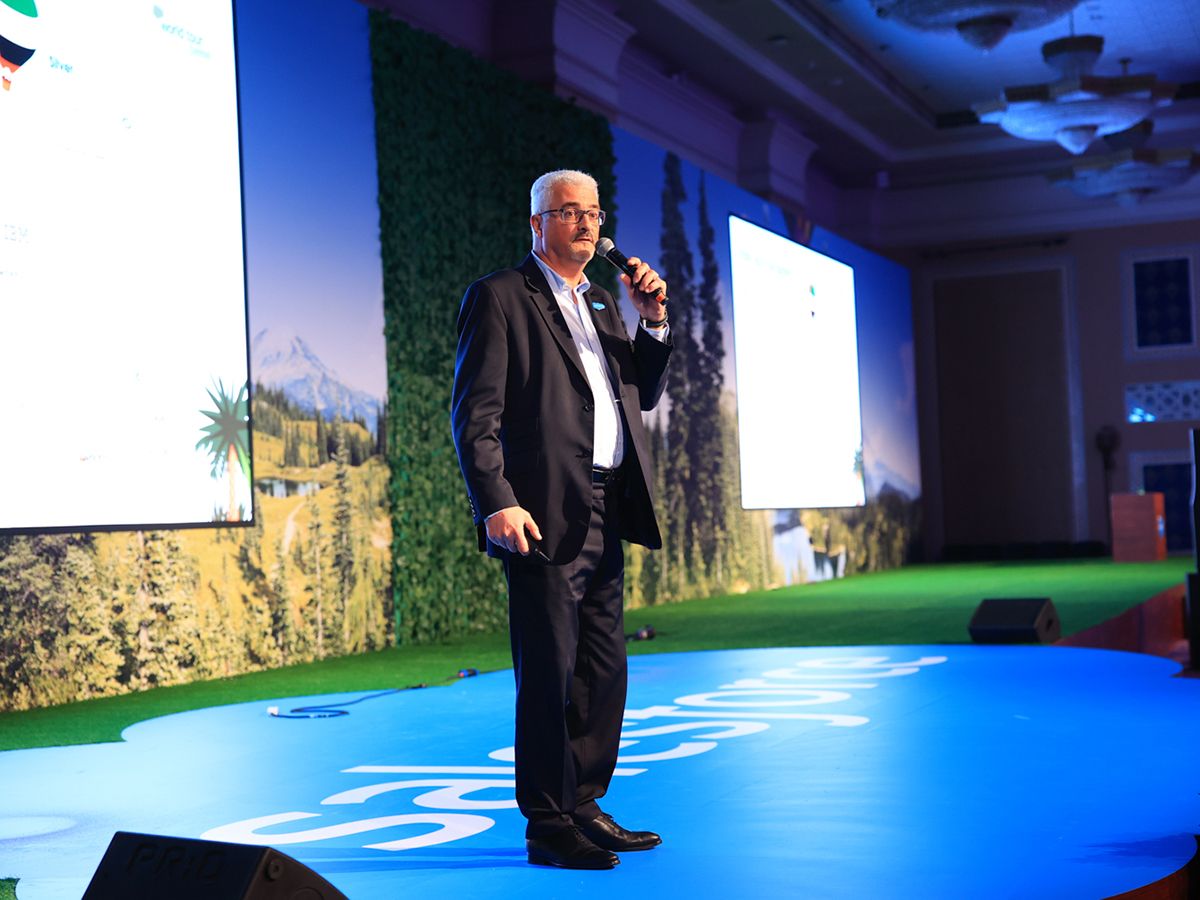
Image credit: Gulf News

Einstein 1

At the heart of this growth is the newly launched Einstein 1 platform, which embeds Generative AI into workflow processes across all Salesforce applications, including sales, service, marketing, ecommerce and analytics. Data, of course, is at the centre of this revolutionary technology – specifically Data Cloud, a platform that creates a holistic customer view by integrating reams of organisations’ existing, disconnected data, and fuses it with Generative AI to improve both customer engagement and employee productivity.

“Seventy-one per cent of companies in the enterprise space have siloed data, on lots of different systems and models, spread across old and new systems. Einstein 1 allows you to ensure that this data will be actionable in your business,” says Nicault. “The key part is that we’re using Gen AI on your company’s grounded data, which you have built for the past few decades and spent millions to maintain, and not on internet or public domain data.”

The company has agreements with leading data providers such as Snowflake, Google Cloud, AWS, MS Azure, and Databricks to allow such integrations securely. This goldmine of company-specific data combined with Generative AI allows the seamless automation of processes, and the reduction of repetitive tasks which, Salesforce research shows, takes up 62 per cent of employees’ time at present.

“The result is a combination of improved employee productivity and better customer service, bringing a lot of value in terms of the ability to decrease costs while increasing customer satisfaction,” Nicault says.

Making a mark in the Middle East

This increase in efficiency and productivity is the reason for the rapid adoption of such AI and cloud technology in the region, since it matches the UAE’s ‘growth mindset’, explains Nicault.

“The government’s vision to build this country as an economic, tourist and cultural destination is absolutely amazing. Our cloud and AI-powered CRM solutions support this because they are effective across sectors including travel, retail and real estate, and it’s starting to pick up very nicely in healthcare and banking, and the public sector,” he says, adding that local case studies have shown that the platform brings about steady growth without organisations having to increase their workforce thanks to improved productivity.

Need for training

The issue, of course, is that such assimilation of evolving technology can bring with it a skills gap, and according to Salesforce’s research, employers in the UAE have some work to do. Findings show that 52 per cent of workers have not been trained to use Generative AI, and 64 per cent say that employers haven’t set any guidelines for Gen AI usage.

This mismatch between the use of AI and training in AI is among the reasons why Salesforce places such an emphasis on training and education, as demonstrated by its 35 per cent increase in partner certifications and its support for technology skills in the region. “Our job has always been to help democratise technology,” says Nicault. “One way we do that is through our free training website, Trailhead, which allows anybody to learn in-demand skills, earn credentials, and connect to opportunities. The second thing is that we have specific programmes and regular workshops to help our partners up-skill. And thirdly, we are engaging with external organisations and associations such as ArabiaForce Academy, which helps to upskill the Arabic-speaking world.”

It’s also why the company is taking a leadership role in AI through Einstein Trust Layer, a robust set of features and guardrails that protect the privacy and security of organisations’ data, improves the safety and accuracy of their AI results, and promote the responsible use of AI across the Salesforce ecosystem.

“We have taken time to ensure that our Gen AI features and services are accurate and safe to use,” Nicault says. “We may not be seen as the fastest innovator in AI, but we do it fast in the most secure way possible.”

This article originally appeared in Reach by Gulf News. You can find it here

Leave a comment

Filed under Articles, Technology

Interview with… Ghada Sawalmah

Image credit: Gulf News

The private sector is set to play a crucial role in the growth of Dubai’s dynamic and rapidly developing healthcare industry, says Ghada Sawalmah, CEO of Gargash Hospital.

“Since private hospitals are the primary investors, it is likely that the healthcare sector will experience growth driven by private hospitals in the future,” she explains. “We anticipate an increase in the number of private hospitals entering the market to take a share of the pie.”

According to current projections by the Dubai Healthcare City Authority, the UAE’s expenditure on healthcare is set to rise to Dh126 billion by 2027, with spending by the private sector growing at a projected CAGR of 8.8 per cent, compared to a CAGR of 7.5 per cent for the public sector.

Gargash Hospital is part of this burgeoning ecosystem of private hospitals, becoming the first female-owned and -led hospital in the country when it opened the doors just before the start of the COVID-19 pandemic. But Sawalmah’s understanding of the healthcare business stretches much further back – to her childhood, growing up as the daughter of two doctors, and watching her mother, Dr Husnia Gargash’s trailblazing journey as the country’s foremost fertility expert.

“I would often go to the clinics and hospitals where they worked since I was very young. I used to carefully watch my parents and their coworkers and how their actions affected the patients,” she recalls. “Being raised in a household of entrepreneurs allowed me to cultivate and enhance my business skills as well. I came to understand that my interest lay more in overseeing the business side of healthcare rather than practising as a doctor.”

The pandemic effect

That deep-seated knowledge helped Sawalmah steer the hospital through the difficult Covid years. “As a new hospital, we had to make numerous changes to our patient flow, employee management, and facility management,” she explains. “The pandemic proved to us that survival was a team sport, not only within the hospital but also within the healthcare community in Dubai. Sharing of knowledge, equipment, human resources, and PPEs was the need of the hour, and everyone stepped up to the task.”

The remarkable response to the pandemic by the UAE is one of the key reasons for the projected growth in the private healthcare sector in the upcoming years, believes Sawalmah. “After the pandemic, there has been a rise in the number of people visiting the UAE, whether for tourism or employment purposes. A significant factor for this increase is the swift and effective management of the pandemic by the UAE government.”

According to government estimates, the population of Dubai is predicted to reach 5.8 million by 2040, and when it comes to medical tourism, the UAE and Dubai, in particular, tops the list as the number one destination in the region. In 2022, the emirate received a record 674,000 medical tourists from Asia, Europe and the Middle East and North Africa, who spent Dh992 million, an increase of Dh262 million from 2021.

“This indicates that a larger number of healthcare facilities will be needed to cater to the healthcare needs of the increasing population and medical visitors,” says Sawalmah. “There will be a rise in the use of new technologies and the creation of Centres of Excellence (CoE) to draw in medical tourists. The current players will either enhance their range of services or establish strategic collaborations to grow their patient base.”

Developing such strategic collaborations is the focus of Gargash Hospital’s own evolution in the near future, including major partnerships with the likes of Tarabichi Stammberger Day Surgical Center, Swift Day Surgical Center and BritishCare. “We aim to establish ourselves as strategic allies and collaborate with other healthcare professionals to offer top-notch healthcare services to our patients,” she says.

Digital healthcare

At the heart of all this development is, of course, technology. Driven by the learnings from the COVID-19 crisis, the UAE’s digital healthcare market is projected to grow from $1.06 billion (Dh3.67 billion) in 2022 to $4.42 billion by 2030, a CAGR of a whopping 19.6 per cent, according to recent industry estimates.

However, this rapid growth and assimilation of new technologies comes with a unique set of challenges for private healthcare providers, who need to juggle the costs of the technology with shifting government regulations.

“The most recent technologies demand significant financial investments for acquisition as well as implementation,” she says. “Another obstacle is combining the latest technology with the current healthcare information system (HIS), which may involve upgrading or modifying the existing HIS, resulting in additional expenses. The regulatory requirements for digital healthcare and new technologies are always changing.”

This article originally appeared in the Gulf News. You can find it here

Leave a comment

Filed under Articles, Health

Interview with… Dr. Khaled Awad

CMC Hospital treats tachycardia in a dextro-transposed heart with multiple ablations

It was a case no one else was ready to take on – a heart condition so rare that even the Mayo Clinic has recorded just 30 cases in the past 20 years – and a patient with a history of going into cardiac arrest during surgical procedures. But for Dr Khaled Awad, Electrophysiologist and Interventional Cardiologist at Clemenceau Medical Center Hospital (CMC Hospital), it was a chance to give a woman her life back.

“Everybody was telling her, ‘we can’t do it’, but she was really suffering,” says Dr. Awad. “For years, even with high dosages of anti-arrhythmia drugs, she would have a heart rate going up to 180 for many hours, every couple of days.” For people with her condition, this was potentially life-threatening, he says, because it could trigger sudden cardiac death.

Born with dextro-transposition – a rare congenital heart defect where the position of the pulmonary artery and aorta are swapped – and the survivor of open-heart surgery as an infant, this 36-year-old woman from Saudi Arabia is a medical rarity for the simple reason that most born with this condition don’t live long, passing away due to heart failure. It took the doctors at CMC Hospital three weeks of preparation, reading the sparse medical literature and doing imaging scans before taking on this “once-in-a-lifetime case”, doing a tricky three-hour procedure involving multiple ablations – introducing a catheter into her blood vessel, and using heat or cold energy to create burns on the heart to stop the electrical signals causing the tachycardia.

“One week later, she is off medications, doing well and happy to live,” says Dr Awad. “She will be able to watch her daughter go off to university, where she plans to study to become a doctor, perhaps even a cardiologist!”

This and other cutting-edge procedures are the mainstay of the Electrophysiology and Pacemaker Clinic in Dubai at CMC Hospital – one of the few such specialised clinics in the city for the treatment of all disorders of heart rhythms. These include the implantation of sophisticated Cardiac Resynchronization Therapy (CRT) devices to prevent heart failure, and the latest therapies such as Conduction System Pacing (CSP), a revolutionary treatment where the pacemaker closely mimics the natural physiological pacing of the heart, considerably reducing adverse outcomes – done two months ago at CMC.

“To the best of my knowledge, this is the first time it has been done at a private hospital in the entire MENA region,” says Dr Awad, one of only eight specialised electrophysiologists in the UAE.

Growing word of mouth means that the clinic has patients coming to them from different countries such as Pakistan and Lebanon for treatment. The reason is that electrophysiology – the study of the electrical impulses governing heart rhythms – as a specialised discipline is relatively new. Often, it is interventional cardiologists who deal with these devices and procedures, and they might lack the expertise to do so.

“There are a lot of young people who have a pacemaker put in, even when the indication was not correct. It hurts me when I see them,” Dr Awad says, adding that it could mean multiple procedures to maintain or replace the device during their lifetime. “An electrophysiologist has special training and perspective, and we might not see the indication for a pacemaker or an intervention at all.”

Access to specialists of this sort is especially crucial because these procedures are so very sophisticated and delicate. “Everything in electrophysiology is about millimetres; if you’re millimetres away during an ablation, you could damage or perforate the heart,” he says.

This is clearly a specialty that is set to grow in this region in the near future, and the Electrophysiology and Pacemaker Clinic at CMC Hospital is right at the forefront of this change.

This article originally appeared in the Gulf News. You can find it here.

Leave a comment

Filed under Articles, Health

Interview with… Circa Biotech

Company forays into uncharted territory to build a circular food waste management solution

Image credit:  Stefan Lindeque | Special to Reach by Gulf News

When you are building a pioneering biotechnology company, you have to build the very path to walk on. That is what three UAE-based entrepreneurs discovered when they began Circa Biotech, an innovative start-up that upcycles food waste into high-quality animal feed using industrial insect farming – the first of its kind in the region.

In order for Dr Haythem Riahi, CEO of Circa Biotech, and his co-founders, Kristine Wong and Liudmila Prozorova, to see their vision of sustainability come to life, they had to relentlessly draw courage and inspiration from their belief in the project. There was no legislative precedent for the sort of industrial insect farming they had in mind – feeding the indigenous Black Soldier Fly larvae with organic food waste redirected from landfills, harvesting the larvae after a short 14-day period to generate high-quality protein feed for fish and poultry, and then creating organic fertiliser from their by-products.

For them to even begin operations at Masdar City in Abu Dhabi, a new category of operating licence had to be created, and they needed to convince several governmental bodies – the Ministry of Environment, Environment Agency – Abu Dhabi, Abu Dhabi Agriculture and Food Safety Authority – that their insect farming was not harmful for the environment or people.

That was just the beginning – they still needed companies to invest in what was then perceived as a crazy idea. “We were laughed at, so many times,” recalls Riahi. But that didn’t stop them. “The three of us are PhDs with MBAs,” he says. “But the first quality we share is resilience.”

Passion for sustainability

What kept them going was their dedication to making the world a better place for future generations. For Riahi, that determination stemmed from becoming a father, and realising that a planet struggling with climate change and food shortage cannot be his children’s legacy.

“By 2050 – in just 27 years – the world will be lacking 200 million tons of protein for animal feed, and we will not be able to feed the 10 billion people on the planet,” he explains. “We all need to become passionate about sustainability, about the way we live, produce and eat.”

That passion gave the three founders the courage to take the leap of faith needed to give up their corporate jobs and transition into entrepreneurship. And slowly but surely, their work began to be noticed.

Moment of glory

The moment they knew that they were truly on the path to success was when Mariam bint Mohammed Almheiri, Minister of Climate Change and Environment, inaugurated their facility in 2022, signing a Memorandum of Understanding (MoU) and pledging her support. It was a reaffirmation that the company was aligned with the UAE’s food security strategy for the next 20 years.

“Our first KPI is not what we are generating in revenue; it is zero food waste,” says Riahi. “We don’t want to see any more food dumped in landfills, causing harmful methane emissions.”

Towards a better tomorrow

To that end, Circa Biotech aims to upscale its industrial capacity to produce 22,000 tons of animal feed a year by processing 200 tons of food waste a day, placing it in the top 10 companies in the world when it comes to alternative food protein.

“Today, the UAE is number four globally when it comes to food waste,” he says. “We want to go from that to making the UAE one of the top five sources of alternative protein in the coming five years.

“The solution will not come only from us. We were licence number 1 in this field of activity; now it’s open to others to come and operate in the sphere.”

For these trailblazers, that would be the greatest achievement – to see an entire ecosystem of start-ups and SMEs in the UAE follow them along the path they have built towards a sustainable future, paved with passion, belief and resilience.

This article originally appeared in Reach by Gulf News. You can find it here.

Leave a comment

Filed under Articles, dubai, People, Sustainability

Interview with… The Waste Lab

Women-led start-up defies naysayers to become a sustainability trailblazer

Image supplied by Lara Hussein (left) and Ceylan Uren (right)

When Lara Hussein and Ceylan Uren gave up their jobs during the height of the pandemic to tackle the problem of food waste and climate change, many thought they were out of their minds. “Everyone said, ‘You have great stable jobs, don’t do this,’” recalls Uren, 30, an architect.

But the co-founders of The Waste Lab refused to be deterred. “We decided it was now or never. The pandemic had us asking big questions, and we couldn’t just close our eyes and go back to our corporate lives.”

They spent months talking to farmers and soil scientists in southern Turkey to create a completely nature-based composting start-up that would redirect food scraps from landfills and, as a result, reduce methane emissions and enrich the soil.

Overcoming obstacles

Despite facing multiple obstacles, such as investors who favoured technology-heavy solutions over nature-based ones, the women remained undaunted. “Everyone was looking for a technology-heavy solution, the next shiny object, and our technology was just nature,” explains 38-year-old Hussein, a communications and customer relationship specialist.

“But we realised we shouldn’t be working against nature or trying to outsmart it. We must learn from it and mimic it in a way that fits our modern age.” They persevered, found angel investors and sustainability-focused incubators, and launched their paid services in December 2021.

A growing success story

Today, the Dubai-based company has built pioneering partnerships with well-known brands such as The Hilton group, Pullman Dubai Creek City Centre, Vox Cinemas, Coffee Planet, and won a grant from Visa’s She’s Next program. Their pilot urban composting site at The Sustainable City became a community centre and permanent fixture. They have diverted 112 tons of food waste from landfills, which is equivalent to 129 tons of CO2 emissions, thanks to acquisition of farmland in 2022 allowing for larger-scale operations.

For the co-founders, this is just the beginning. They now lead a team of 12 and plan to expand their service to other emirates. They want to work with local farmers, grow their own food using compost and encourage others to join them in understanding the cycle of life and building a sustainable future.

From grit to glory, The Waste Lab’s journey is a testament to the power of determination, innovation and authentic passion. As they continue to rise every day, they inspire us all to join them on this fascinating journey of triumph.

This article originally appeared in Reach by Gulf News. You can find it here.

Leave a comment

Filed under Articles, dubai, People, Sustainability

Interview for Sarath Babu’s Lifestyle Blog

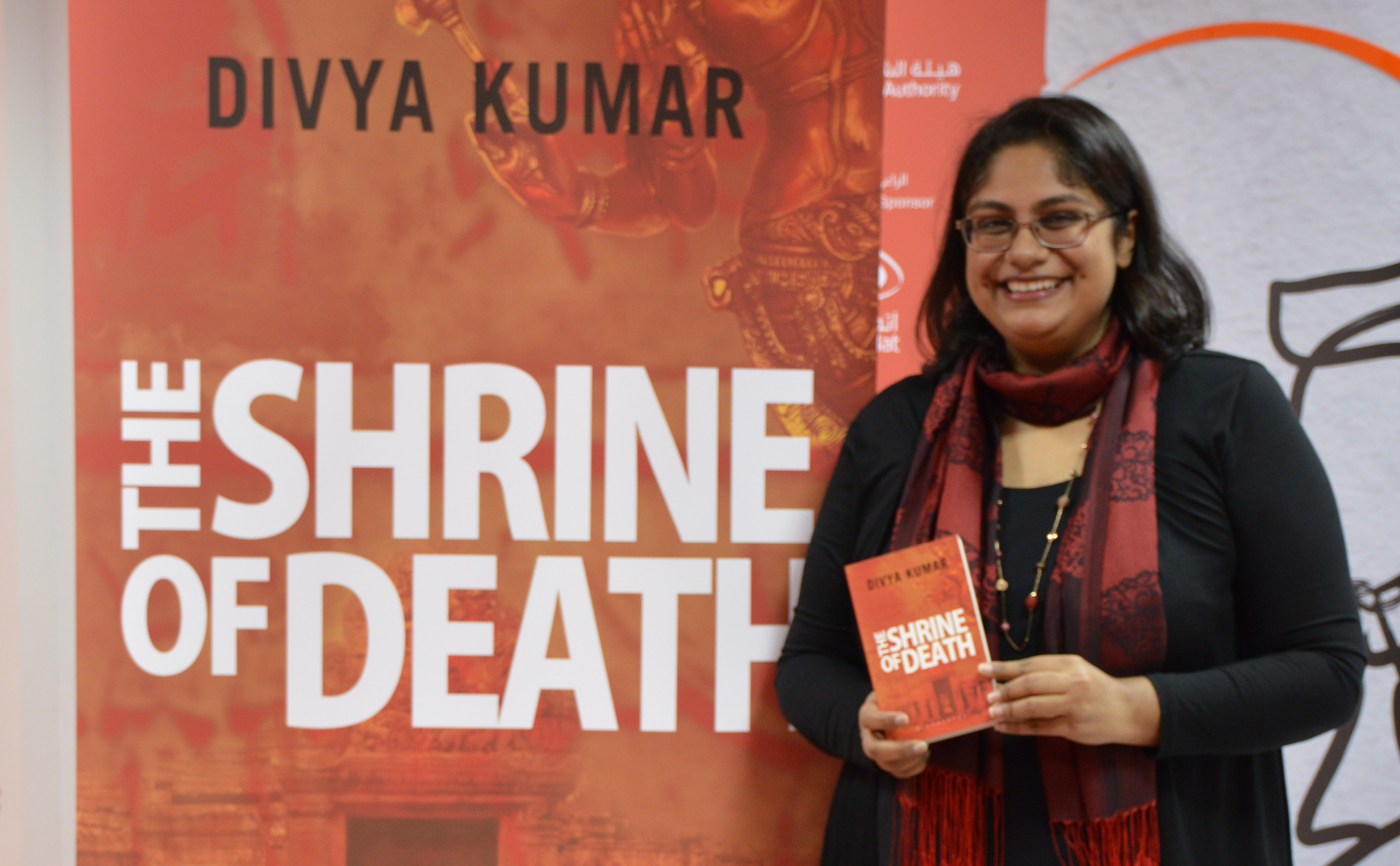
I was recently interviewed by Chennai-based blogger Sarath Babu about my experience writing and having ‘The Shrine of Death’ published…

DSC_0081


1.What motivates you to write?
Love of the story and the characters! That, I’ve realised, is the only thing that makes you want to keep writing, that brings you back to the book again and again, amidst all the periods of self-doubt and low inspiration. That’s what happened for me with ‘The Shrine of Death’ – the story wouldn’t let me go.


2. How did you feel after publishing your book?
For someone like me, who has always loved books and reading, to see my own words within the covers of a novel was an incredible feeling, almost surreal. I remember holding it in my hands for the first time and feeling almost tearful. It was, quite literally, a dream come true.


3. What are some of your favourite novels and authors?
I love reading fiction across all genres — I enjoy Edgar Allan Poe and Anne Rice as much as I do Georgette Heyer or P. G. Wodehouse. Crime writer Dick Francis is an old favourite of mine – Ilove the way he deftly draws his characters and their emotional lives, as much as the way he sets up his fast-moving plots. I love the dark and brooding atmosphere that Daphne Du Maurier conjures up in her all novels and short stories. I recently re-discovered the thrillers of Ira Levin — what a fascinating variety of plots he came up with! And I love the gentle humour and kindness in the writing of James Herriot.
4. Is there a specific reason for naming your novel?


I had actually given it a different name in the beginning – ‘The Empath’. But my editor Himanjali Sankar and others at Bloomsbury India felt that wasn’t the most evocative title, especially since many people may not even know what an empath was (and I could see their point!) So, she asked me for some alternative titles, and ‘The Shrine of Death’ was the most popular of the ones I came up with. As for why it’s called that, it has to do with a special sort of Chola temple called a pallipadaithat is central to the mystery in my book. These are sepulchral shrines built to honour dead kings and queens – i.e. shrines of death! To know more about how the title came to be,you can check out this post in my blog: https://divyakumar.com/2018/04/05/why-the-shrine-of-death/.


5. Where do you write from? Do you go to some specific place, like beach side or the hills? 
I wish! Most of my writing for this book was done at home since I began working on it at the time when I gave up my full-time job as a reporter to become a stay-at-home mom. I still do the same… I generally write at my spot on the couch or at my desk, either after everyone is asleep at night, or after everyone has left home in the mornings! But there are also times when I just need to get away from it all to write, and then my go to is usually a coffees hop. Both in Chennai before, and in Dubai now, I have certain favourite cafes where I love to go, order a cappuccino and write.


6. What inspired you to write the books (in general)? Any tales to tell…
I grew up in a home filled with books, and I’ve just loved stories for as long as I can remember.I wrote my first story, about a turtle and fish who were best friends, when I was five years old, and my childhood and teens are littered with ambitious novels I began and abandoned. And that doesn’t count all the stories I’ve made up in my head and never put down on paper! Working as a journalist with The Hindu Metroplus, I covered the book beat, attending book launches and interviewing authors, and that was definitely a source of inspiration as well, meeting all these creative people and hearing their stories.


7. What was your biggest learning experience throughout the writing process?
The process of writing and rewriting, working and reworking, the steps that go into converting that first draft, the idea in your head, into something whole and complete, something cohesive and engaging. I’ve done that for feature articles, of course, but a 95,000-word novel is something else altogether!


8. Looking back, what did you do right that helped you break in as a writer?
I think there’s no better training ground for becoming an author than working as a journalist. Just the act of writing and editing everyday hones your abilities. It teaches you to cope with days when the words just aren’t coming that easily. It teaches you economy with words. It teaches you to be ruthless with your own writing. And exposes you to so many new experiences and interesting people.


9. Any best piece of writing advice that you would like to share with new or struggling writers? 
Just keep going! This is neither new nor original advice, but it’s the only thing that works – to keep writing. If you’re feeling blocked or burnt out, take a break, take a breather, but then come back to it.


10. Something personal about you people may be surprised to know?
Like my main protagonist Prabha, I have a degree in computer science! But unlike her, my shift in careers happened early on – I did a second degree in journalism, and except for a brief stint as a web developer, had moved completely away from coding by my mid-20s.


11. Any future books that you would like to discuss now?
I’m actually working on a sequel to ‘The Shrine of Death’, and I’m hoping to do a trilogy eventually. You will get to know what happened next with the characters in TSoD, and there are, of course, many strange and disturbing new developments!


12. What other profession excites you the most?
If I wasn’t a writer, I would love to be part of the music industry, as a singer, songwriter or composer!


13. Any special mention about your reader (be it with reviews/feedback or anything else)
The responses from readers are what matter to me the most, hands down. Nothing makes me happier than hearing from someone that they loved a particular aspect of the story or a were drawn to one of the characters; that they enjoyed curling up with the book while sick or during a long flight or layover; that they couldn’t put it down, and had to race to the end! To be able to share this story that was in my head for so long, and to see how people who love to read like myself respond to it… it’s just the best part.


14. Do you write the story at a stretch or you take your time to complete it? If you take a longer time, wouldn’t you be forgetting the story? How do you tackle it?
I tend to write in fits and bursts – I write intensely for stretches, then go through phases when I’m not writing that regularly. But I’m in no danger of forgetting the story! In fact, the periods when I’m not writing is often when I keep mulling certain plot points in my head, and come up with ideas to fix any issues in the story.


15. Traditional or Self-Publishing? Why?
I don’t know if I’m really equipped to comment on that, since I’m just one book old, and haven’t tried self-publishing. I do see the pros and cons of both though, and can understand why authors may choose one or the other. For now, I see myself sticking with traditional publishing, but who knows, maybe it’ll change in the future!


16. How is the response so far for the book? 
It’s been so encouraging! I’ve gotten good to great reviews from newspapers, bloggers, and readers alike, and I really couldn’t have asked for more as a first-time author.

Leave a comment

Filed under Fiction, Interviews, The Shrine of Death, Uncategorized

Interview for the Bookaholicanonymous Blog

Loved doing this interview with Smita Singh for the amazing Bookaholicanonymous Blog!

download

“I was quite clear that this was not a historical novel. It was to be a fast-paced contemporary thriller with elements of Chola history woven in” Divya Kumar

Bookaholicanonymous is extremely happy to present Divya Kumar, author of the novel ‘The Shrine of Death’. The book is a chilling crime thriller in which a beautiful young historian who discovered two priceless bronzes from the 10th century disappears without a trace. Her friend sets out to find her and is drawn into a world of fraud, murder and betrayal where no rules apply. Get hold of this racy thriller, we gurantee its unputdownable! 

About Divya Kumar: Divya is a journalist, writer and blogger, earlier based in Dubai now Chennai. She spent her early 20s studying and working in the U.S., dabbling in web-design and media studies, before settling down to a career in journalism. She returned to India in 2006, and joined ‘The Hindu’ in Chennai, working as a senior reporter and feature writer with ‘The Hindu’ Metroplus for five years, covering mainly the book and art beat, before taking a break for the birth of her first child in 2011.

This is your first book right, what made you finally dive into the world of letters/books and become an author?
I’ve wanted to write a book for as long as I can remember. I’ve always been an avid reader – a bookaholic, in fact! – especially of fiction across all genres. And my childhood and adolescence are littered with novels I began and never got around to completing. As a features journalist in The Hindu in Chennai, I got to cover the book beat extensively, attending book launches and interviewing authors, and of course, reading all the books that came my way with relish. Through it all, the dream of writing my own book remained a constant. But it wasn’t until I took a break from full-time reporting for the birth of my daughter that I finally got started. And this book idea was different – it took root in my head and didn’t let me go, and unlike all those other times, I actually finished writing it!

How did the idea of the book come to you? 
Quite literally in a dream! I woke up one morning with the character and tragic backstory of Jai, the empath, lingering in my mind. At that time, The Hindu was doing in-depth coverage of the bust of the idol smuggling ring allegedly headed by the Manhattan-based Subhash Kapoor, and the two parts – the character of the empath, and the idol theft plot came together in my mind almost as a complete whole.

Did you deliberately choose to not go in to the detailed history of the time (Chola kingdom) you have chosen to write about?
Yes, it was a conscious choice made as I wrote the book. I was quite clear that this was not a historical novel. It was to be a fast-paced contemporary thriller with elements of Chola history woven in, and I didn’t want to bog down the narrative with long paragraphs of historical detail. The reader learns the pertinent facts along with my main character Prabha as she uncovers them, through her conversations with the professor, or through books she or Jai read, so that the history I reveal – about the great Queen Sembiyan Mahadevi, and about ancient sepulchral shrines or pallipadais – feel like an integral part of the scene, rather than a heavy info-dump that becomes a speed bump in the plot.

How much research did you have to do on idol thefts? Did being a journalist help you? 
The research was primarily trawling through all the newspaper coverage of high-profile idol thefts stretching back a couple of decades, especially in The Hindu, and also going through the Tamil Nadu Idol Wing website, which had considerable detail on thefts they had uncovered. Being a journalist certainly helped me in sifting through the various sources of information and using them optimally.

How long did it take to finish writing the book?
About three and a half years. But the writing was not continuous. I began, as I mentioned, when my daughter was a baby, so initially I wrote only late into the nights or on weekends. I was also, during that period, doing a weekly column for The Hindu Metroplus and doing freelance reporting as well, so my work on the book often happened in fits and starts. I’d write intensely for periods and not at all for stretches in between. It wasn’t until the final six months that I was focused entirely on the book and its completion.

You know Chennai more than any other city in India, is that why you based your novel on the city?
Yes, Chennai is the city of my birth, and although I grew up for most part in Muscat, Oman, I returned to Chennai every summer to my grandparents’ house. It was the place I came to for college, and then again returned to after studying for a while in the U.S. Most of the important milestones of my life are linked to Chennai – it’s the place where I began my career as a journalist and writer, where I met my husband and got married, where my daughter was born… So when I began to write my first book, it was only natural that Chennai would have a starring role in it!

Which of your characters did you develop first?
Jai, the empath. As I mentioned, his character arrived almost fully-formed in my head, and I knew from the start that I wanted to explore his past traumas and his struggles with his abilities alongside the idol theft mystery.

Did you weave a little bit of yourself in the character of Prabha as you were a Computer Science student?
I guess I did! Prabha is definitely not me – she’s very much her own distinct person. But I suppose I did use certain aspects of my experiences and my life in shaping hers. One, as you mentioned, is the transition from computer science to journalism – though mine happened under very much more mundane circumstances than hers! And the other, maybe, is her search for roots and finding them in Chennai, something I went through after drifting between Muscat, India and the U.S. for the better part of a decade in my late teens and 20s.

Did you have someone in mind while developing the character of Gerard Ratnaraj? 
Not really. He’s a composite of the cops I read about while researching the idol thefts, with a liberal dose of my imagination thrown in!

When and what can we expect from your next book? 
The ‘when’ is uncertain… all I can say is that I’m working on it and am about half way through currently. As for the ‘what’… It picks up a few years after ‘The Shrine of Death’ and takes us back into the lives of the three main characters, Prabha, Jai and Gerard. Jai is struggling to deal with new aspects of his evolving abilities, even as more of his murky past is unveiled; Prabha is growing into her new career as an investigative journalist but that brings fresh conflict into her relationship with Gerard; and the three of them find themselves fighting against a powerful and dangerous enemy…

Bookaholicanonymous wishes Divya…all the best…and yes we are waiting for your next novel eagerly!

The original interview can be found here

Leave a comment

Filed under Fiction, Interviews, The Shrine of Death, Uncategorized

Interview with… Madhav Chari

Pianist Madhav Chari talks about the spirit of jazz, linking his music to Indian philosophy and his experiential workshops. DIVYA KUMAR listens in

PHOTO: R. RAVINDRAN

If you go to meet jazz pianist Madhav Chari expecting to discuss just jazz or even just music, think again. With mind-whirling rapidity the conversation flows between cognitive science and colonialism, mathematics and anthropology, Indian philosophy and American academia, not to mention martial arts, dance and the Bhakti movement…

At one point, I have to ask him to stop briefly, so I can look back to the original list of questions I’d studiously prepared before the interview. But they seem rather limited — and limiting — now, so I decide to let the conversation take its course, just interjecting the odd query now and again.

“What we’re doing right now is jazz music,” says Madhav, halfway through, during an impassioned (there isn’t any other kind with Madhav) discussion on how jazz is freedom, but with form. “This conversation is not scripted. It’s loosely improvised but you’re still providing direction — that’s jazz music.”

And with that neat journalistic analogy for jazz, the free-flowing chat suddenly makes sense. After all, the essence of any conversation with Madhav Chari is jazz, the music form that grabbed him when he was a six-year-old in Kolkata and hasn’t let go since.

“What about it grabbed me I don’t know,” he muses. Maybe it was his father’s knowledge of jazz from the 1940s, when he saw the big bands of the era play while at The Lawrence School, Lovedale. Or, perhaps the family friend whom he used to watch improvising on the piano. “There was just an emotional connect. It’s like asking why the chocolate cake appealed to you… it’s hard to answer.”

He dismisses his training in Western classical piano as mere calisthenics. “Loosely speaking, yes, I’m trained in Western classical, in the sense that I did the gamut of exams, but it doesn’t mean anything,” he says. “That’s because we learn the music in a context where it wasn’t born, where that form of music isn’t a vibrant, living force, unlike in London, Moscow or Paris.”

This idea of absorbing music as a ‘living force’, of experiencing its spirit, is of intense importance to Madhav. That’s why he cherishes the time he spent in the U.S. at places such as New York or Chicago, where jazz still lives. There was the time, for instance, that he got to play with a local sax legend in Chicago while he was a Ph.D. student at the University of Illinois – Urbana Champaign (UIUC).

“The great pianist Tommy Flanagan, who had recorded with John Coltrane, was sitting in the audience… I saw him and my heart just skipped a beat,” he laughs. “But the music took me over and I forgot my stage fright, and in the end, he congratulated me and gave me his number in New York. These experiences were very important in my search as a jazz musician.”

After his studies, Madhav spent some time as part of the jazz scene in New York and a brief eight months in Toronto before returning to India in 2003 and settling in Chennai, where his parents live. These past seven years have been a period of a spiritual awakening for the pianist, and Indian philosophy has now become an integral part of his musical journey.

“I want to be a jazz musician who thoroughly understands the tradition of the music, but who’s also alive to the possibilities of his own consciousness and has linked himself with the mystical traditions of India,” he says, adding with a smile, “But I don’t play Hindustani music… I’ll be playing the blues.”

He’s also developed some very strong opinions (to put it mildly) on the Indian music scene — whether it’s local jazz or fusion. “I will go on record saying that in the last 40 years, not one musician in Mumbai — the leading jazz centre in India — has tapped the spirit of jazz,” he says emphatically. “They’ve tapped the form, but not the spirit. And that’s why I have a problem with fusion as well, because so much of it is technical and theoretical, with very little experiential insight.”

His own corporate workshops, which he now conducts with martial arts expert George Kurian, focus entirely on just that — the experiential. “We make people do music and martial arts exercises, and allow the gateways of the mind to open up,” Madhav says. “There’s hardly any talking, because I believe that in the modern Indian urban consciousness, language is a tremendous block to understanding. English has blocked our access to our own experiences — it’s a facet of colonialism.”

These beliefs are part of the reason why Madhav has connected with Chennai the way he has since 2003. “It’s not about it being conservative or liberal; it’s about it being open to experiences while being rooted in tradition,” he says of the city. “I’m not impressed by people telling me Bangalore is more hip or modern; modernity is actually old, based on where I want to go in a cosmic sense.”

KEYNOTES

He enjoys the writings of S.N. Balagangadhara, chair of the Comparative Science of Cultures Centre at Ghent University in Belgium, on Hindu philosophy and religion.

He loves the music of American jazz pianist ‘Bud’ Powell. Madhav’s most recent album ‘Parisian Thoroughfares’ is titled after a Powell composition.

He likes Mathematics, in which he has a Masters degree from Dartmouth University

12 Comments

Filed under Articles, People

Interview with… Letika Saran

DGP (Law and Order) Letika Saran, the girl from the hills, talks about her journey to the peak in the plains. DIVYA KUMAR listens in

Photo: R. Ravindran

Trailblazer Letika Saran

A fan of detective novels. A child of the hills. A dog-lover. A concerned mother.

The world knows Letika Saran as the super-achieving cop — she became Chennai’s first woman Commissioner of Police in 2006, and now, at the age of 57, has become the first woman Director-General of Police in Tamil Nadu (and only the second woman to hold that post in the country).

But, half an hour spent with the trim, diminutive lady in her enormous office on Kamarajar Salai, and you get a glimpse into the world of Letika Saran, the woman. You find out that her heart still lies in the hills of Munnar, where she spent her carefree childhood. You find out that she’s currently worried about a mix-up in her daughter Uthara’s return ticket to Perth (she’s a student research scientist there).

You find out that her favourite way to unwind is with her four dogs (two long-haired dachshunds and two recently-acquired pups). And that she still loves reading the detective novels that were part of the reason why she wanted to join the police force in the first place.

“I was always fond of detective novels, and I liked the idea of the police,” she says simply, of her decision to join the Indian Police Service (IPS) after her undergraduate degree at the Women’s Christian College. “I’ve worked in investigation for over 15 years and always found it interesting; so, I’ve never looked back on that decision as anything but the correct one.”

The transition from college girl to cop wasn’t ‘unduly difficult’, she says in her precise way: “Even the physical aspects of training weren’t difficult, as gymnastics was part of our daily routine at my boarding school in Kodaikanal.”

But the hard road truly began from her first posting. “I was one of only two women in the field at my level, and it was like working in a goldfish bowl, with the eye of the public and the department on you,” she says. “You had to constantly prove yourself — not just as Letika Saran but as a woman police officer. Failure wasn’t an option.”

And so, the girl from the hills began to blaze a trail in the plains. But even today, when you speak of Munnar, Letika’s eyes soften. “When you’ve lived in the hills, you identify so closely with the place — even if you haven’t had the time to go back in years,” she says in her clear, flute-like voice. “There’s something familiar about the hills which, perhaps, isn’t there in any other place.”

Still, over the years, Chennai has become home, mostly because, she says ruefully, it’s home for her daughter. “She was born and brought up here and calls it home — so, we don’t have a choice,” she laughs, adding: “As anyone who’s lived here for a long time knows, Chennai is a city that grows on you, and my husband and I really don’t look at living anywhere else.”

Our interview is interspersed with a series of phone calls over her daughter’s ticket mix-up, and super-cop Letika sounds endearingly like any concerned mom as she hangs up and shakes her head: “Here’s the kid not even prepared to travel today, and she’s being told she’s got to be on the flight…”

Juggling her job and family hasn’t always been easy on Letika, but in her no-fuss way, she tells me she was fortunate in having postings that allowed her to be with her daughter when she was very young. “It also helped that she knew exactly how things would be; she was independent right from the beginning,” she says, pride evident.

Today, Letika Saran exudes an air of no-regrets contentment with her life. There isn’t perhaps as much time as she might like for travel — back to the hill stations of her youth, for example — but there are always detective novels to read (“they’re ideal for when you don’t want serious reading”), her dogs which recently doubled in number, and, of course, the passion that has guided her throughout her career.

“From the time that I joined, I always wanted to prove myself as somebody who is competent and capable, who could do the job and get the job done,” she says. “That’s still remains my goal today.”

3 Comments

Filed under Articles, People

Interview with… Sivasankari

Celebrated writer Sivasankari speaks to DIVYA KUMAR on her four-volume masterpiece on India’s literary heritage and her love for social causes

PHOTO: R. RAVINDRAN

It’s been 16 years since celebrated Tamil author Sivasankari wrote a piece of fiction. Those years have been spent in a sort of literary tapas for the cause of regional Indian writing, otherwise known as Knit India Through Literature, her monumental four-volume work on the literary heritage of each of India’s 18 official languages.

The fourth and final volume of Knit India was completed recently (it was launched last month), and the author is in a philosophical mood when we meet one drowsy afternoon at her home in a pretty cul-de-sac of Adyar.

“I have mixed feelings – I’m deeply satisfied to have given back something so solid to my country and to the literary field, but also exhausted after all these years of travel and absolute concentration on this task,” she says. “I always think of it as a yagna that took 16 years.”

Not writing fiction during the entire period was a conscious decision – she wanted no distractions – even though there remained some very definite themes she wanted to explore through her writing. In typical Sivasankari style, these themes are very real, socially relevant and meant to inform even as she entertains (“masala-coating”, she calls it). For instance, she says, she’s wanted to address what women go through during menopause.

“No one has touched upon the subject in an in-depth way; there remains a stigma attached to it,” she says forthrightly. “People are so naïve in dealing with it – even women don’t understand what they’re going through, let alone their families and their husbands.”

Of course, social stigmas have never stopped Sivansankari from tackling issues. She famously addressed drug addiction in the 1980s, and subjects such as artificial insemination and surrogate motherhood back in the 1970s, years before they came to be discussed in the mainstream. “As a writer, one is always looking ahead to the problems that can arise,” says the author of 30 novels and over 150 short stories. “It’s like sitting on the 20th storey of a building and looking into the distance.”

However, fans will have to wait a little longer for the next Sivasankari story. The 66-year-old plans to spend the next six months setting her personal life in order – moving into an apartment and giving away or getting rid of a bulk of her belongings, whether it’s her 400 pattu podavais, the roomful of mementoes received during her illustrious career, or the three rooms of books, papers and correspondence accumulated for Knit India.

“I have to be practical; I’m getting older and since my mother passed away, I’m living alone,” she says, a tinge of pathos colouring the pragmatism. “Who am I going to pass this all on to? If I had children or grandchildren, it would be different.”

Her strong philosophical leanings come to the fore again as she likens this time in her life to the third stage of Hindu dharma, vanaprasta, prior tosanyasa or renunciation. “This process is teaching me to be non-sentimental about my belongings,” she says. “When giving is forced on you, you regret it; if it’s a conscious choice, you enjoy it.”

Not that Sivasankari is new to the art of giving and of social service (she hates that term, she says vehemently; anything one does for the betterment of society is one’s duty and not a special service). For instance, she reveals that she has been conducting 10 weddings anonymously at her temple for the last six years – her aim is to complete at least 100 weddings in the upcoming years. “I want to do as much as I can in my lifetime, with whatever funds I have,” she says.

She pauses for a moment and we simply sit and listen to the birds chirping outside in the sun-dappled garden. “When I die, I want people to say what a wonderful human being Sivasankari was, and incidentally, she was a good writer as well,” she says finally. “That’s my wish.”

KNITTING INDIA

Sivasankari’s massive literary project Knit India Through Literature consists of four volumes of hardback books:

Volume 1 on the languages of the South (from Kerala, Karnataka, Andhra Pradesh and Tamil Nadu)

Volume 2 on the languages of the East (from Assam, Bengal, Manipur, Nepal and Orissa)

Volume 3 on the languages of the West (Konkani, Marathi, Gujarati, and Sindhi)

Volume 4 on the languages of the North (Kashmiri, Punjabi, Urdu, Hindi and Sanskrit)

Each book consists of travelogues of the states covered, interviews with leading writers of each language, a representative selection and an overview of the literature of each region.

7 Comments

Filed under Articles, People