Interview with… The Waste Lab

Women-led start-up defies naysayers to become a sustainability trailblazer

Image supplied by Lara Hussein (left) and Ceylan Uren (right)

When Lara Hussein and Ceylan Uren gave up their jobs during the height of the pandemic to tackle the problem of food waste and climate change, many thought they were out of their minds. “Everyone said, ‘You have great stable jobs, don’t do this,’” recalls Uren, 30, an architect.

But the co-founders of The Waste Lab refused to be deterred. “We decided it was now or never. The pandemic had us asking big questions, and we couldn’t just close our eyes and go back to our corporate lives.”

They spent months talking to farmers and soil scientists in southern Turkey to create a completely nature-based composting start-up that would redirect food scraps from landfills and, as a result, reduce methane emissions and enrich the soil.

Overcoming obstacles

Despite facing multiple obstacles, such as investors who favoured technology-heavy solutions over nature-based ones, the women remained undaunted. “Everyone was looking for a technology-heavy solution, the next shiny object, and our technology was just nature,” explains 38-year-old Hussein, a communications and customer relationship specialist.

“But we realised we shouldn’t be working against nature or trying to outsmart it. We must learn from it and mimic it in a way that fits our modern age.” They persevered, found angel investors and sustainability-focused incubators, and launched their paid services in December 2021.

A growing success story

Today, the Dubai-based company has built pioneering partnerships with well-known brands such as The Hilton group, Pullman Dubai Creek City Centre, Vox Cinemas, Coffee Planet, and won a grant from Visa’s She’s Next program. Their pilot urban composting site at The Sustainable City became a community centre and permanent fixture. They have diverted 112 tons of food waste from landfills, which is equivalent to 129 tons of CO2 emissions, thanks to acquisition of farmland in 2022 allowing for larger-scale operations.

For the co-founders, this is just the beginning. They now lead a team of 12 and plan to expand their service to other emirates. They want to work with local farmers, grow their own food using compost and encourage others to join them in understanding the cycle of life and building a sustainable future.

From grit to glory, The Waste Lab’s journey is a testament to the power of determination, innovation and authentic passion. As they continue to rise every day, they inspire us all to join them on this fascinating journey of triumph.

This article originally appeared in Reach by Gulf News. You can find it here.

Leave a comment

Filed under Articles, dubai, People, Sustainability

Writing Your First Book: A Podcast

An update after simply ages! Hopefully the next one won’t be as long coming 🙂

Fittingly, it’s a look back at the launch of ‘The Shrine of Death’ – the journey of writing, publishing and marketing of it. I was recently approached by the lovely Simiran Choudhary of BrandPodcasters to do a podcast on ‘Writing Your First Book’. It was my first ever podcast, and such a fun experience! Thank you Simiran for reaching out to me… So glad to have connected with you!

The past couple of years have been about dealing with the worldwide pandemic and keeping one’s health and sanity intact. For me, it’s also been about figuring out my next steps after TSOD, which consumed my life for a few years back there, and now, as I stand on the cusp of those next innings (more on that soon, hopefully!), it felt wonderful to look back on that milestone moment of my life — the joys, the ups and downs, and the learnings that will perhaps be of some use to other new authors out there.

It also felt good to open up about my plans for the future, about my creative journey going forward, which I haven’t really done recently (I’ve very much been in hermit mode during the pandemic, as you might have noticed!). With 2022 winding to a close, this podcast ended up being as much about the past as it is about the future, and I am so happy to share it with you 🙂 If you have some time to spare this holiday season, do have a listen!!

Spotify:https://open.spotify.com/episode/7zroGUQ66orz9wdCcUcSTJ?si=e6096e234940492f

Apple Podcasts:https://podcasts.apple.com/us/podcast/16-basics-of-book-marketing-with-divya-kumar/id1643385080?i=1000590359140

Google Podcasts: https://podcasts.google.com/feed/aHR0cHM6Ly9mZWVkcy50cmFuc2lzdG9yLmZtL3dyaXRpbmcteW91ci1maXJzdC1ib29r/episode/YjViNzc4YTItYzA5MC00MDNhLWJkMDktMDVkZWRhY2FmMWM5?sa=X&ved=0CAUQkfYCahcKEwjg7O6rj4j8AhUAAAAAHQAAAAAQAQ

2 Comments

Filed under Fiction, Interviews, The Shrine of Death

Interview for Sarath Babu’s Lifestyle Blog

I was recently interviewed by Chennai-based blogger Sarath Babu about my experience writing and having ‘The Shrine of Death’ published…

DSC_0081


1.What motivates you to write?
Love of the story and the characters! That, I’ve realised, is the only thing that makes you want to keep writing, that brings you back to the book again and again, amidst all the periods of self-doubt and low inspiration. That’s what happened for me with ‘The Shrine of Death’ – the story wouldn’t let me go.


2. How did you feel after publishing your book?
For someone like me, who has always loved books and reading, to see my own words within the covers of a novel was an incredible feeling, almost surreal. I remember holding it in my hands for the first time and feeling almost tearful. It was, quite literally, a dream come true.


3. What are some of your favourite novels and authors?
I love reading fiction across all genres — I enjoy Edgar Allan Poe and Anne Rice as much as I do Georgette Heyer or P. G. Wodehouse. Crime writer Dick Francis is an old favourite of mine – Ilove the way he deftly draws his characters and their emotional lives, as much as the way he sets up his fast-moving plots. I love the dark and brooding atmosphere that Daphne Du Maurier conjures up in her all novels and short stories. I recently re-discovered the thrillers of Ira Levin — what a fascinating variety of plots he came up with! And I love the gentle humour and kindness in the writing of James Herriot.
4. Is there a specific reason for naming your novel?


I had actually given it a different name in the beginning – ‘The Empath’. But my editor Himanjali Sankar and others at Bloomsbury India felt that wasn’t the most evocative title, especially since many people may not even know what an empath was (and I could see their point!) So, she asked me for some alternative titles, and ‘The Shrine of Death’ was the most popular of the ones I came up with. As for why it’s called that, it has to do with a special sort of Chola temple called a pallipadaithat is central to the mystery in my book. These are sepulchral shrines built to honour dead kings and queens – i.e. shrines of death! To know more about how the title came to be,you can check out this post in my blog: https://divyakumar.com/2018/04/05/why-the-shrine-of-death/.


5. Where do you write from? Do you go to some specific place, like beach side or the hills? 
I wish! Most of my writing for this book was done at home since I began working on it at the time when I gave up my full-time job as a reporter to become a stay-at-home mom. I still do the same… I generally write at my spot on the couch or at my desk, either after everyone is asleep at night, or after everyone has left home in the mornings! But there are also times when I just need to get away from it all to write, and then my go to is usually a coffees hop. Both in Chennai before, and in Dubai now, I have certain favourite cafes where I love to go, order a cappuccino and write.


6. What inspired you to write the books (in general)? Any tales to tell…
I grew up in a home filled with books, and I’ve just loved stories for as long as I can remember.I wrote my first story, about a turtle and fish who were best friends, when I was five years old, and my childhood and teens are littered with ambitious novels I began and abandoned. And that doesn’t count all the stories I’ve made up in my head and never put down on paper! Working as a journalist with The Hindu Metroplus, I covered the book beat, attending book launches and interviewing authors, and that was definitely a source of inspiration as well, meeting all these creative people and hearing their stories.


7. What was your biggest learning experience throughout the writing process?
The process of writing and rewriting, working and reworking, the steps that go into converting that first draft, the idea in your head, into something whole and complete, something cohesive and engaging. I’ve done that for feature articles, of course, but a 95,000-word novel is something else altogether!


8. Looking back, what did you do right that helped you break in as a writer?
I think there’s no better training ground for becoming an author than working as a journalist. Just the act of writing and editing everyday hones your abilities. It teaches you to cope with days when the words just aren’t coming that easily. It teaches you economy with words. It teaches you to be ruthless with your own writing. And exposes you to so many new experiences and interesting people.


9. Any best piece of writing advice that you would like to share with new or struggling writers? 
Just keep going! This is neither new nor original advice, but it’s the only thing that works – to keep writing. If you’re feeling blocked or burnt out, take a break, take a breather, but then come back to it.


10. Something personal about you people may be surprised to know?
Like my main protagonist Prabha, I have a degree in computer science! But unlike her, my shift in careers happened early on – I did a second degree in journalism, and except for a brief stint as a web developer, had moved completely away from coding by my mid-20s.


11. Any future books that you would like to discuss now?
I’m actually working on a sequel to ‘The Shrine of Death’, and I’m hoping to do a trilogy eventually. You will get to know what happened next with the characters in TSoD, and there are, of course, many strange and disturbing new developments!


12. What other profession excites you the most?
If I wasn’t a writer, I would love to be part of the music industry, as a singer, songwriter or composer!


13. Any special mention about your reader (be it with reviews/feedback or anything else)
The responses from readers are what matter to me the most, hands down. Nothing makes me happier than hearing from someone that they loved a particular aspect of the story or a were drawn to one of the characters; that they enjoyed curling up with the book while sick or during a long flight or layover; that they couldn’t put it down, and had to race to the end! To be able to share this story that was in my head for so long, and to see how people who love to read like myself respond to it… it’s just the best part.


14. Do you write the story at a stretch or you take your time to complete it? If you take a longer time, wouldn’t you be forgetting the story? How do you tackle it?
I tend to write in fits and bursts – I write intensely for stretches, then go through phases when I’m not writing that regularly. But I’m in no danger of forgetting the story! In fact, the periods when I’m not writing is often when I keep mulling certain plot points in my head, and come up with ideas to fix any issues in the story.


15. Traditional or Self-Publishing? Why?
I don’t know if I’m really equipped to comment on that, since I’m just one book old, and haven’t tried self-publishing. I do see the pros and cons of both though, and can understand why authors may choose one or the other. For now, I see myself sticking with traditional publishing, but who knows, maybe it’ll change in the future!


16. How is the response so far for the book? 
It’s been so encouraging! I’ve gotten good to great reviews from newspapers, bloggers, and readers alike, and I really couldn’t have asked for more as a first-time author.

Leave a comment

Filed under Fiction, Interviews, The Shrine of Death, Uncategorized

Travel: At this Azerbaijan fire temple, Sanskrit and Punjabi inscriptions find place

Ateshgah 2

Photo credit: Shyam V. Krishnamurthy

Ateshgah, it turns out, is a fascinating little relict of history, of globalisation and the inter-cultural exchange between the Indian sub-continent and Europe

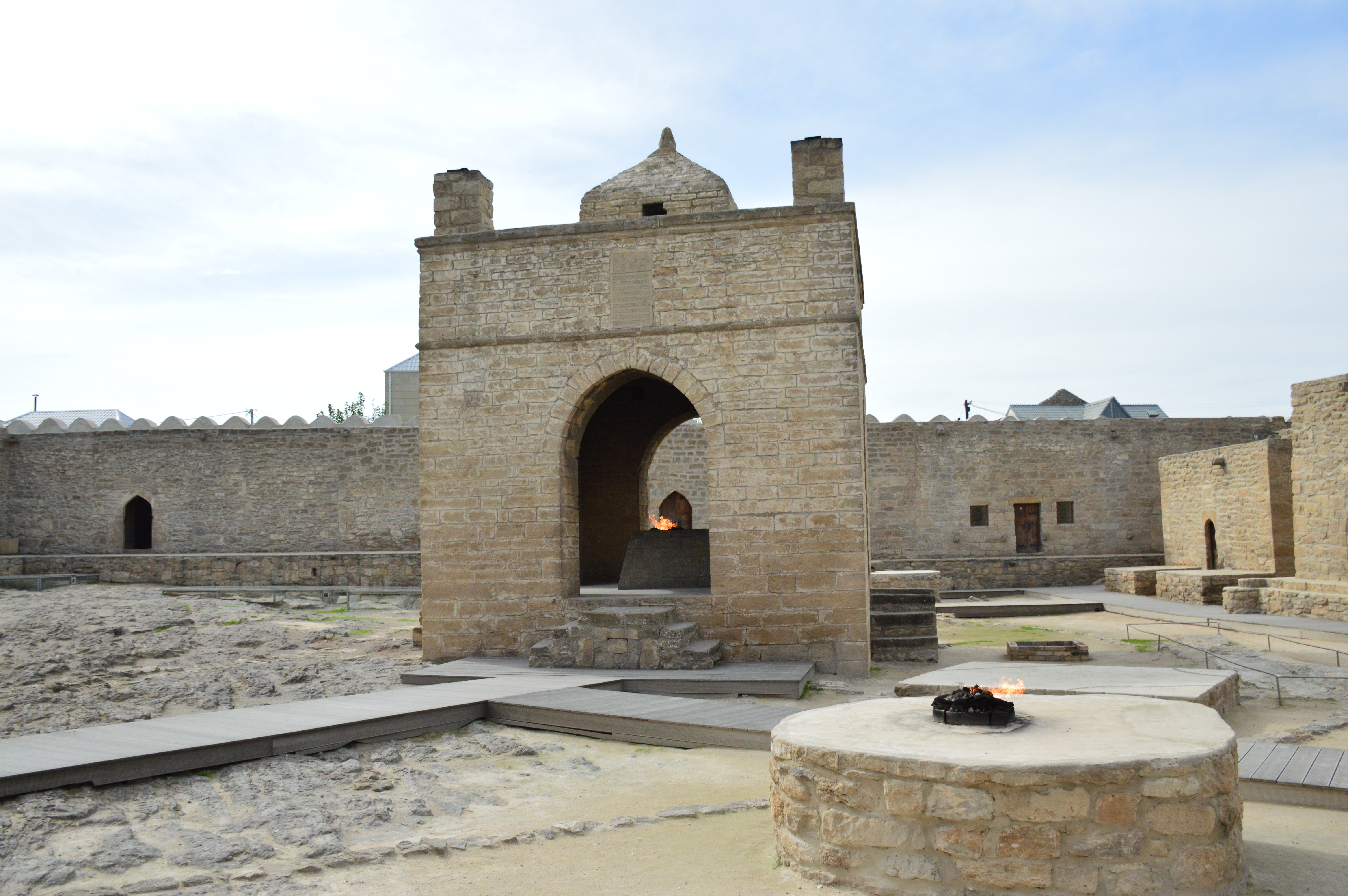
Shri Ganeshaya Namah is not an incantation you’d expect to see etched in the heart of Azerbaijan, the tiny Muslim-majority, former Soviet nation on the banks of the Caspian Sea. But it’s what catches my eye on a stone archway as we enter Ateshgah, a fire temple near Surakhani, Azerbaijan.

There are five more lines in Devanagari, invoking, among others, Jwala Ji, the Hindu deity of fire.

There are similar inscriptions in Sanskrit or Punjabi on almost every doorway leading into the pentagonal fire temple compound, all left behind by Hindu and Sikh travellers to the region over 500 years ago.

Ateshgah, it turns out, is a fascinating little relict of history, of globalisation and the inter-cultural exchange between the Indian sub-continent and Europe, dating back to the 16th century.

Azerbaijan was part of the Silk Route that connected Asia and Europe, and it is believed that merchants from the Indian subcontinent came to hear of the legend of the ‘burning earth’ and ‘eternal flames’ that the Absheron peninsula in Azerbaijan was renowned for (Azerbaijan, in fact, is often referred to as ‘The Land of Fire’). And so, Indian travellers and pilgrims arrived in the late 16th and early 17th century, building Ateshgah in its current form, and worshipping the sacred flames alongside their own gods such as Ganesha and Shiva.

Open flames

On the day of our visit to the temple, the wind is very strong, whipping up dust around us; we are, after all, less than 20 km from the capital city of Baku, unofficially called the ‘City of Wind’ in Azeri. But the sacred flame in the raised main fire altar at the centre of the temple compound burns on regardless.

That central flame, and the open flames that burn in the two circular platforms on the side are today lit by Baku’s main pipeline of gas. But for hundreds, maybe thousands of years, they were a naturally occurring phenomenon, the result of the country’s massive natural gas reserves that leaked through holes in the rocky surface, igniting into flames as it came into contact with air.

Zoroastrian origins

These ‘eternal flames’ have been venerated by fire-worshippers throughout Azerbaijan’s history — there are mentions as far back as the 7th century by travellers to the region. Indeed, historians believe that the fire temple itself existed in an earlier form, built by Zoroastrians long before the Indian travellers came.

Part of an older structure was found beneath the current one during renovations done at the temple in 1969, and the name ‘Ateshgah’ comes from Persian, meaning ‘house of fire’. There are indications that the old temple might have extended beyond the existing perimeter, but any remains were most likely destroyed when the surrounding land was excavated for oil and gas from the late 19th century onwards.

That was also what caused the end of the glorious natural phenomenon of the eternal flame — the aggressive century-long mining of the natural gas reserves meant the flames went out by 1969. And possibly the reason why worship ended at the temple in the late 19th century as well — historians speculate that the pilgrims were driven away by the setting up of petroleum plants in the Surakhani region.

A pilgrimage site

But thankfully, the 500-year-old temple itself still stands, and retains traces of its multicultural past. The central altar isn’t purely Hindu in its structure, with similarities to traditional Zoroastrian fire altars, and one of the inscriptions in the temple compound is in Persian as well. The Zoroastrian influence in Azerbaijan is old but deeply rooted, a remnant of the days when pre-Islamic Persian dynasties ruled the region. Even today, Nuvroz, the Zoroastrian new year celebration, is a major festival in their calendar.

Fittingly enough, according to historical accounts, Ateshgah in the 19th century became a pilgrimage site for Parsis from Bombay who came to visit the Indian temple that was once a Zoroastrian place of worship.

Following its restoration in 1969, the temple was converted into a museum in 1975, and was officially listed as a Unesco World Heritage Site in 1998.

Today, each of the tiny cells that line the pentagonal perimeter of the compound tells stories of the pilgrims and ascetics who lived there, showing them doing tapasya, draping themselves in heavy iron chains or indulging in extreme acts of self-denial and fasting. Chants of Om Gam Ganapataye Namah float out of one cell, another houses a Nataraja bronze, and yet another displays shards of pottery used in rituals long ago.

The author of The Shrine of Death is a journalist, sometime singer-songwriter and full-time mom, based in Dubai.

This article originally appeared in The Hindu’s Sunday Magazine supplement.

Leave a comment

Filed under Articles, Travel, Uncategorized

‘The Shrine of Death’ is featured in Malayala Manorama Online!

The article is in Malayalam, but the video of me talking about the book at the end is in English! 🙂

https://gulf.manoramaonline.com/indepth/sharjah-international-book-fair-2018/The-Shrine-of-Death-novel-SIBF.html?fbclid=IwAR2p7Z1vVVrI9KX89H6m93ihCt38zOKFx5zOZgUzIAJJoZ159meDakAN–0#

Leave a comment

Filed under Media coverage, The Shrine of Death, Uncategorized

Article: Divya’s debut novel is a thriller on stolen antiques

Following the launch at the SIBF 2018, this interview appeared in one of the region’s leading English dailies, the Khaleej Times

DSC_0081

The fiction title is a fast-paced thriller deal with the issue of idol theft and is a heady mix of crime, mystery, romance and the paranormal.

For debutant Indian novelist Divya Kumar, the protagonist in her maiden book The Shrine of Death had to be a woman. “It was a no-brainer,” she explained to Khaleej Times, after launching her book at the Sharjah International Book Fair late last week.

The Dubai-based author and former journalist’s first book was published by Bloomsbury India in April 2018. The fiction title is a fast-paced thriller deal with the issue of idol theft and is a heady mix of crime, mystery, romance and the paranormal.

“The book is a fictionalised account of actual events that occurred in Tamil Nadu in 2009 when a set of ancient Chola idols disappeared from an abandoned temple and were later discovered to have been smuggled out of the country,” said Kumar.

“This was the watershed case that eventually leads to the high-profile arrest of Manhattan-based art dealer and smuggler Subhash Kapoor.”

The book’s central character – Prabha Sinhan – is an IT professional who gets pulled into the murky world of idol theft and goes in search of her missing friend Sneha Pillai.

“Mainstream Indian media often portrays a certain stereotype of women in mass media. Like a manic pixie dream girl, or a virtuous, pious woman, or an oversexed glam doll, or even a confused, flaky millennial,” she added.

Kumar’s character had to be a relatable, regular young woman who was not epitomised in any manner. “I also wanted my character to be strong, stubborn, and fiercely loyal,” she said.

A former journalist of The Hindu newspaper in India, Kumar moved to Dubai in 2016. “I finished a big chunk of the editing and re-writing process in the UAE,” she added.

Though the book had its first release in India, Kumar said she is extremely proud of being part of the Sharjah book fair.

“I wanted to write fiction for pretty much my whole life. From childhood, I’ve had a set of unfinished books and manuscripts. I worked at The Hindu from 2006 – 2011, but I stopped working full-time after my daughter was born,” she said.

She began seriously working on the novel, and it took shape after details of the Chola idols case unearthed.

“I was still with The Hindu when the bust of the idol smuggling ring was in the news. From a local case in Tamil Nadu, the case went international as it was linked to an international crime ring. It was covered extensively in the India media and I followed it with a lot of interest.”

For Kumar, the theme was a perfect fit for her book as she got increasingly fascinated with the subject. “The plot evolved out the details of the case,” she added.

As she began writing the book, Kumar imagined it to be part of a trilogy. “I am definitely working on a sequel,” she added.

dhanusha@khaleejtimes.com

The original article appeared here in the Khaleej Times.

2 Comments

Filed under Fiction, Interviews, Media coverage, The Shrine of Death, Uncategorized

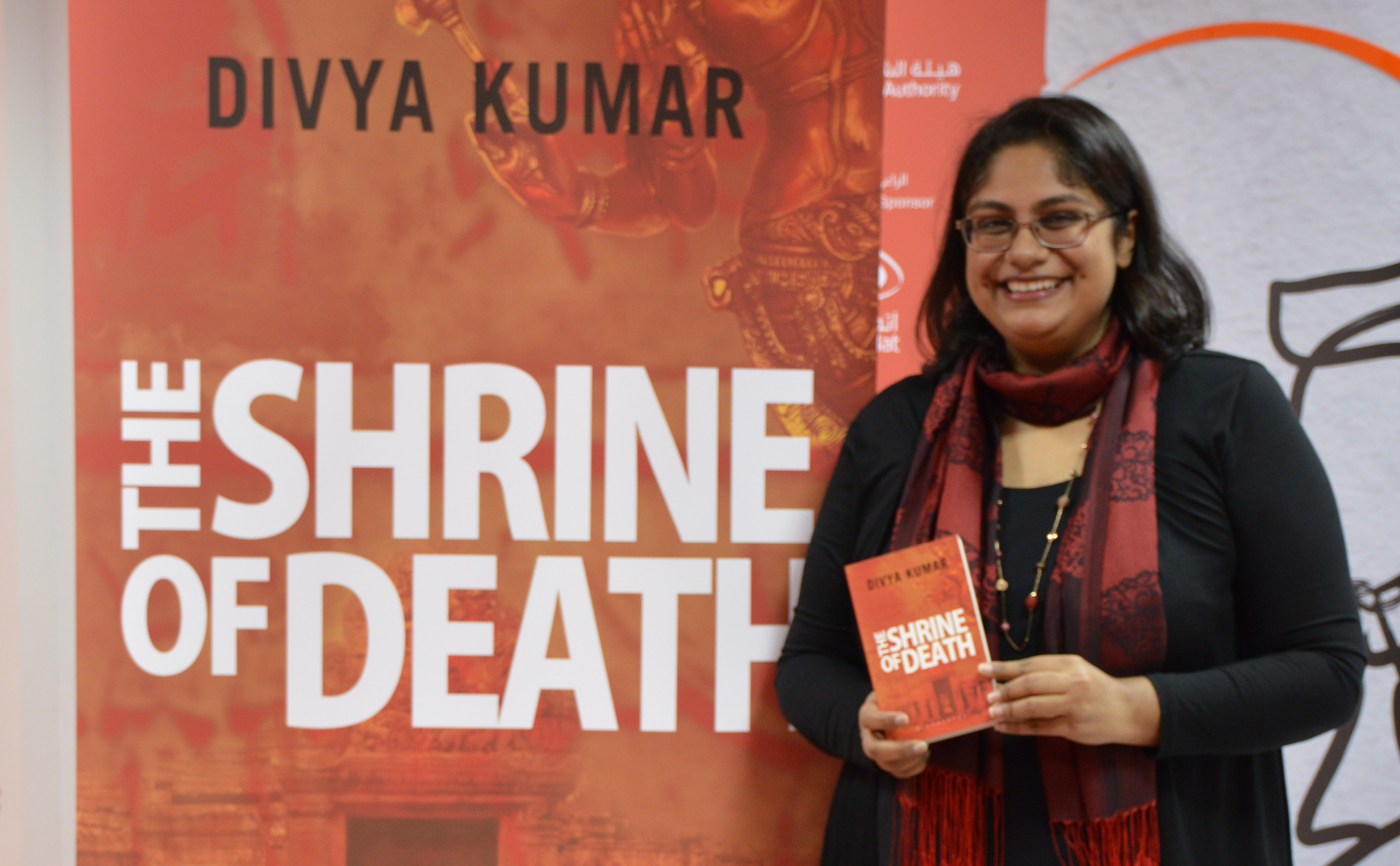
‘The Shrine of Death’ launched at the Sharjah International Book Fair 2018!

My debut novel, ‘The Shrine of Death’ was recently launched at the prestigious Sharjah International Book Fair 2018 — the third largest book fair in the world, and the largest in the region!

45327677_10156101215916859_5799594116174053376_o

Look what’s on the shelf at the SIBF 2018!

Here’s a glowing report of the launch in the Gulf Today

SHARJAH: Debutant Indian novelist Divya Kumar received overwhelming response as she introduced “The Shrine of Death” to booklovers at the ongoing Sharjah International Book Fair (SIBF).

Published by Bloomsbury India, the novel was released in India in April 2018 to glowing reviews by the press and readers alike. Since then its arrival was awaited by the UAE book aficionados.

It is a fast-paced thriller dealing with the hot-button issue of idol theft, and has a heady mix of crime, mystery, romance and the paranormal.

During a conversation at the SIBF with the acclaimed poet and author Anuradha Vijayakrishnan, Kumar said that the book is a heavily fictionalised account of actual events that occurred in Tamil Nadu, India, in 2009, when a set of ancient Chola idols disappeared from an abandoned temple, and were later discovered to have been smuggled out of the country. This was the watershed case that eventually led to the high-profile arrest of Manhattan-based art dealer and smuggler Subhash Kapoor.

“The Shrine of Death” tells the story of Prabha Sinha, an IT professional in the south Indian city of Chennai, who is plunged into a murky world of idol theft, murder, and betrayal after she gets a mysterious phone call one night from her old friend Sneha Pillai. As she races to find answers before the people she loves get hurt, she seeks the help of Jai Vadehra, a troubled young man with a tragic past, and police officer Gerard Ratnaraj of the Idol Wing, CID, whom she can’t help but be drawn to. Their search takes them from Chennai’s newsrooms and universities to the abandoned sepulchral shrine of a Chola queen in the heartland of Tamil Nadu. And here there is a twist in the tale.

Divya Kumar is a journalist, writer and blogger, currently based in Dubai. She spent her early 20s studying and working in the US, dabbling in web-design and media studies, before settling down to a career in journalism. After returning to India, she joined The Hindu newspaper in Chennai, writing for The Hindu Metroplus, covering mainly the book and art beat.

“I started writing this book when I took a break for the birth of my first child. Naturally, it took me three years to complete the book. Fortunately, I didn’t have to run after dozens of publishers. The only difficulty I faced was to convince famous literary agent Kanishka Gupta to have a look at my work. Once he agreed to, it was quite smooth as the editor, Himanjali Sankar, also had confidence in my work,” she added. Encouraged by the tremendous response, she has already started working on its sequel.

Currently available at Jashanmal Books stand at the SIBF, the title will shortly be available at leading bookstores in the UAE.

45731009_10156105114616859_403384883218481152_n

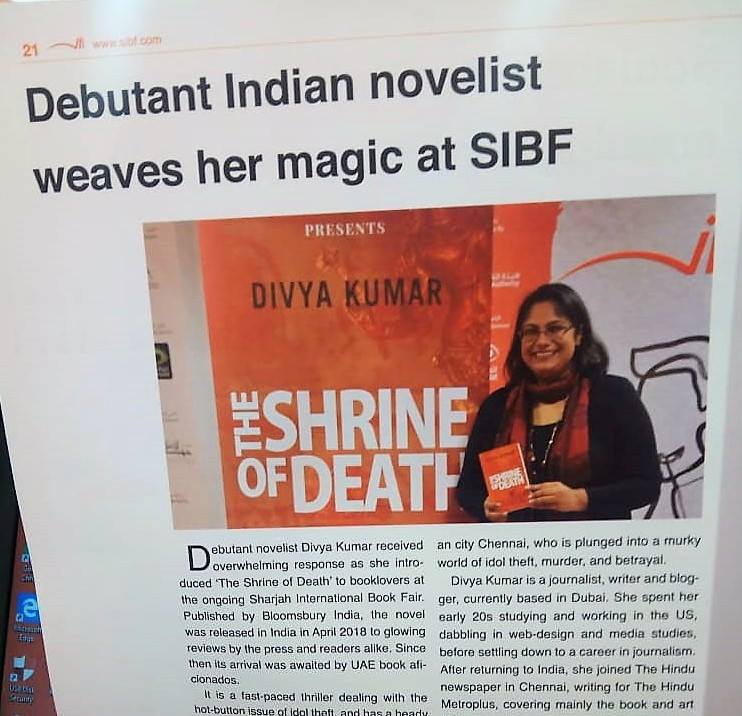
Also featured in the SIBF 2018 newsletter! 🙂


Leave a comment

Filed under Fiction, Media coverage, The Shrine of Death, Uncategorized

Of Writing and Motherhood

This was written for the Guest Blog section of the amazing Bookaholicanonymous blog.

 I have been writing for as long as I remember. I wrote my first story when I was around 5, about a fish and a turtle that were friends. This was followed by a comic-book series drawn in pencil over school summer holidays, about a pair of naughty twin boys called Tissy and Tassy. Then came the Enid Blyton-inspired stories about sassy kids who went on picnics and solved mysteries in their holidays, followed by never-completed novels of teenage angst and romance, and even a reincarnation-based story in college that I lost along with all other data when my crappy Windows 95 system crashed.

But in my 20s, following my journalism degree and my grad school years, while working in my first real job as a features reporter at The Hindu, I found myself, for lack of a better word, stuck. I ought to have been the most inspired I’d ever been. I ought to have been churning out stories. Here I was, being exposed to interesting people and stories, every single day, on the job. Here I was, attending book launches, speed reading new novels by Indian authors, and getting to interview them about the process of writing. It was a dream come true for a young wannabe novelist. And yet, I found myself paralysed. When it came time to try and work on my own writing, I couldn’t seem to make progress. I had ideas, sure; I’d sit and try working on some of them, but it would come out sounding stilted. And worse, I wasn’t inspired to keep going.

I talked about it all the time though, so much so that it came to be known as ‘The Book’ in my family, the one I would someday write. The Great Indian Novel, or something like that. Then marriage happened, then the birth of my daughter in my early 30s. I was intense about motherhood, from the start. I wanted to be hands-on, so I quit my full-time job. I was the archetypal over-involved first-time mom. I Googled everything. I worried about everything. I overthought everything. But I also thoroughly enjoyed all those firsts, all those incredible moments of babyhood and toddlerhood, the ones that become picture postcards in your mind, and then get passed on as stories to your kid as she gets older and wants to hear about “when she was a baby”. And of course, I wrote about them too, in blogs and a column.

But something else was happening at the same time, almost silently. I was working on a book, in stolen moments at night, while my baby slept, or on weekends when my husband shooed me out of the house to go take a break. Not ‘The Book’, but just a book. Not some hopelessly elevated ideal, but just a story I wanted to tell, like the ones I wrote in my childhood. Just for myself, what I’d myself want to read. This time, I didn’t talk about it much. It was like a little secret I hugged to my chest. I wasn’t even ever sure I wanted to publish it. I just wanted to write it. It wasn’t until it was complete, some three and a half years later, that I knew I wanted to try and put it out there. That story, of course, became ‘The Shrine of Death’.

I often wonder what made the difference. What broke the paralysis. And I believe it was motherhood. I believe that motherhood liberated me. I know that seems contradictory. After all, motherhood, in a lot of ways, shackles you. Your time isn’t your own, your energy isn’t your own, your mind even isn’t your own, filled as it is with thoughts and worries and fears about the little person who’s wholly dependent on you. But motherhood also gives you a brand of confidence, a belief in your ability to tough it out in the trenches. “If I’ve managed to care for this little life, then what is a mere story?” It puts everything in perspective, and it frees you from any delusions of grandeur you might possess. Suddenly, the story I’d been obsessing about and building up in my head for years was just that – a story. It didn’t have to arrive perfectly formed in my head or become The Great Indian Novel. If there’s one thing motherhood teaches you, it’s that everything in this life, including yourself and your efforts, is less than perfect, but no less meaningful for it. That the most important things in life are messy and hard, and that the only thing to do is just keep going.

I’ve always been terrified of screwing up, of being less than perfect. Hence, you can probably guess, the paralysis when it came to doing anything that was really important to me. But with motherhood, not doing was not an option. I was responsible for this tiny human being, and so I had to do, terrified or not, and – amazingly! – we both survived. I made mistakes, and beat myself up about it, yes, but then I got up, dusted myself off, and moved on, because, again, there was no other option. It just had to be done, and you know what, I did okay.

Every single day as a mother, especially in the early months, holds innumerable moments of failure and triumph. It’s exhausting, but it’s also the biggest life lesson there is.

Now, I like to say I’m the mom of two – of my firstborn child, and of my firstborn book. Neither journey was easy, but I know in my heart that if it hadn’t been for the first, I may have never completed the second.

You can find the original blog post here.

Leave a comment

Filed under Blog, Motherhood, Uncategorized

A rave review for ‘The Shrine of Death’ in the Indian Express!

shrine of death-R1 (Final)

Book: The Shrine of Death
Author: Divya Kumar
Publication: Bloomsbury India
Pages: 296 
Price: 399

If reading Divya Kumar’s The Shrine of Death while stretched out on a beach somewhere, remember to slap on some sunscreen and order enough beer to last you at least a couple of hours. Because once you start on this book, it’s unlikely you’ll set it down before you race to the end. The Shrine of Death has all the ingredients required for a thrilling beach read: an ambitious and beguiling beauty who stumbles onto a web of conspiracy and then vanishes, two amateur detectives — one of whom is harbouring a disquieting secret — and a dishy love interest (a man in uniform, no less).

The plot is fairly straightforward: IT professional Prabha Sinha gets an unsettling phone call from her old friend, Sneha, and is drawn into an investigation of her disappearance and the theft of some priceless Chola sculptures. The book switches between Prabha’s perspective, and that of the troubled Jai, who is, for reasons of his own, helping her figure out what happened to Sneha.

Apart from the deftly managed suspense, what draws the reader in is Kumar’s ability to flesh out characters. One gets a real sense of the emotional stakes involved, and, as the story progresses, the stakes only get higher. Given the premise — that of heritage loot, a major problem in India — this book could have quite easily been overloaded with research. But the writer maintains a light touch, although there should still be enough to satisfy art history and archaeology wonks.

This review for ‘The Shrine of Death’ was part of a round up of this season’s detective novels the Indian Express’ book section. You can read about all the other fabulous novels in the list here


Leave a comment

Filed under Fiction, Media coverage, The Shrine of Death, Uncategorized

Interview for the Bookaholicanonymous Blog

Loved doing this interview with Smita Singh for the amazing Bookaholicanonymous Blog!

download

“I was quite clear that this was not a historical novel. It was to be a fast-paced contemporary thriller with elements of Chola history woven in” Divya Kumar

Bookaholicanonymous is extremely happy to present Divya Kumar, author of the novel ‘The Shrine of Death’. The book is a chilling crime thriller in which a beautiful young historian who discovered two priceless bronzes from the 10th century disappears without a trace. Her friend sets out to find her and is drawn into a world of fraud, murder and betrayal where no rules apply. Get hold of this racy thriller, we gurantee its unputdownable! 

About Divya Kumar: Divya is a journalist, writer and blogger, earlier based in Dubai now Chennai. She spent her early 20s studying and working in the U.S., dabbling in web-design and media studies, before settling down to a career in journalism. She returned to India in 2006, and joined ‘The Hindu’ in Chennai, working as a senior reporter and feature writer with ‘The Hindu’ Metroplus for five years, covering mainly the book and art beat, before taking a break for the birth of her first child in 2011.

This is your first book right, what made you finally dive into the world of letters/books and become an author?
I’ve wanted to write a book for as long as I can remember. I’ve always been an avid reader – a bookaholic, in fact! – especially of fiction across all genres. And my childhood and adolescence are littered with novels I began and never got around to completing. As a features journalist in The Hindu in Chennai, I got to cover the book beat extensively, attending book launches and interviewing authors, and of course, reading all the books that came my way with relish. Through it all, the dream of writing my own book remained a constant. But it wasn’t until I took a break from full-time reporting for the birth of my daughter that I finally got started. And this book idea was different – it took root in my head and didn’t let me go, and unlike all those other times, I actually finished writing it!

How did the idea of the book come to you? 
Quite literally in a dream! I woke up one morning with the character and tragic backstory of Jai, the empath, lingering in my mind. At that time, The Hindu was doing in-depth coverage of the bust of the idol smuggling ring allegedly headed by the Manhattan-based Subhash Kapoor, and the two parts – the character of the empath, and the idol theft plot came together in my mind almost as a complete whole.

Did you deliberately choose to not go in to the detailed history of the time (Chola kingdom) you have chosen to write about?
Yes, it was a conscious choice made as I wrote the book. I was quite clear that this was not a historical novel. It was to be a fast-paced contemporary thriller with elements of Chola history woven in, and I didn’t want to bog down the narrative with long paragraphs of historical detail. The reader learns the pertinent facts along with my main character Prabha as she uncovers them, through her conversations with the professor, or through books she or Jai read, so that the history I reveal – about the great Queen Sembiyan Mahadevi, and about ancient sepulchral shrines or pallipadais – feel like an integral part of the scene, rather than a heavy info-dump that becomes a speed bump in the plot.

How much research did you have to do on idol thefts? Did being a journalist help you? 
The research was primarily trawling through all the newspaper coverage of high-profile idol thefts stretching back a couple of decades, especially in The Hindu, and also going through the Tamil Nadu Idol Wing website, which had considerable detail on thefts they had uncovered. Being a journalist certainly helped me in sifting through the various sources of information and using them optimally.

How long did it take to finish writing the book?
About three and a half years. But the writing was not continuous. I began, as I mentioned, when my daughter was a baby, so initially I wrote only late into the nights or on weekends. I was also, during that period, doing a weekly column for The Hindu Metroplus and doing freelance reporting as well, so my work on the book often happened in fits and starts. I’d write intensely for periods and not at all for stretches in between. It wasn’t until the final six months that I was focused entirely on the book and its completion.

You know Chennai more than any other city in India, is that why you based your novel on the city?
Yes, Chennai is the city of my birth, and although I grew up for most part in Muscat, Oman, I returned to Chennai every summer to my grandparents’ house. It was the place I came to for college, and then again returned to after studying for a while in the U.S. Most of the important milestones of my life are linked to Chennai – it’s the place where I began my career as a journalist and writer, where I met my husband and got married, where my daughter was born… So when I began to write my first book, it was only natural that Chennai would have a starring role in it!

Which of your characters did you develop first?
Jai, the empath. As I mentioned, his character arrived almost fully-formed in my head, and I knew from the start that I wanted to explore his past traumas and his struggles with his abilities alongside the idol theft mystery.

Did you weave a little bit of yourself in the character of Prabha as you were a Computer Science student?
I guess I did! Prabha is definitely not me – she’s very much her own distinct person. But I suppose I did use certain aspects of my experiences and my life in shaping hers. One, as you mentioned, is the transition from computer science to journalism – though mine happened under very much more mundane circumstances than hers! And the other, maybe, is her search for roots and finding them in Chennai, something I went through after drifting between Muscat, India and the U.S. for the better part of a decade in my late teens and 20s.

Did you have someone in mind while developing the character of Gerard Ratnaraj? 
Not really. He’s a composite of the cops I read about while researching the idol thefts, with a liberal dose of my imagination thrown in!

When and what can we expect from your next book? 
The ‘when’ is uncertain… all I can say is that I’m working on it and am about half way through currently. As for the ‘what’… It picks up a few years after ‘The Shrine of Death’ and takes us back into the lives of the three main characters, Prabha, Jai and Gerard. Jai is struggling to deal with new aspects of his evolving abilities, even as more of his murky past is unveiled; Prabha is growing into her new career as an investigative journalist but that brings fresh conflict into her relationship with Gerard; and the three of them find themselves fighting against a powerful and dangerous enemy…

Bookaholicanonymous wishes Divya…all the best…and yes we are waiting for your next novel eagerly!

The original interview can be found here

Leave a comment

Filed under Fiction, Interviews, The Shrine of Death, Uncategorized